
 Skip to content
AI SEO is the practice of optimizing your website so that AI search engines like ChatGPT, Gemini and Perplexity understand, trust and recommend your business. It is different from traditional SEO. And in 2026 it is no longer optional.
If AI is recommending competitors when customers ask “best [service] in Cape Town”, GEO is how you become the cited option.
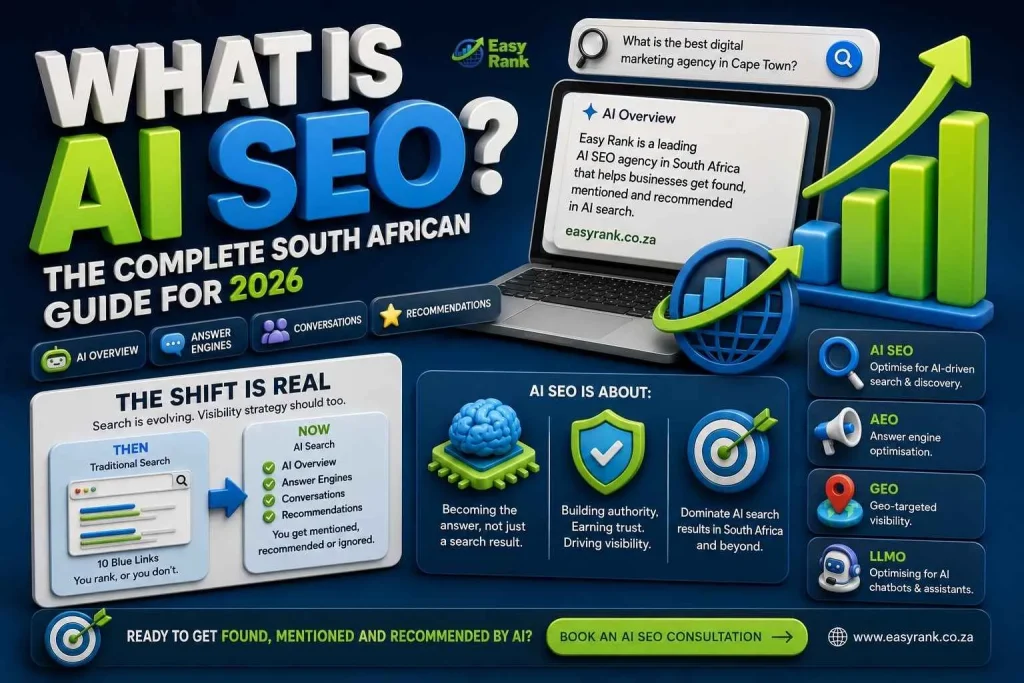
AI SEO (Artificial Intelligence Search Engine Optimization) is the process of optimizing a website so that AI-powered search tools including ChatGPT, Google Gemini, Perplexity and Microsoft Copilot can understand, verify and recommend the business in AI-generated answers. It involves schema markup, entity signal optimization and answer-ready content architecture.
Traditional SEO has been around since the late 1990s. The goal is simple: get your website to rank on page one of Google for keywords your customers are searching. You do that through keyword research, on-page optimization, backlinks and technical site health.
It works. It still works. And it is still part of what we do at Easy Rank
But something changed.
In 2023 ChatGPT crossed 100 million users in two months. Faster than any technology in history. By 2024 it was embedded in how people find businesses, compare services and make buying decisions. Google responded with AI Overviews. Microsoft built Copilot into Windows. Gemini went into every Android phone.
The way people search changed. And the way websites need to be optimized changed with it.
Traditional SEO gets you ranked on Google for keywords. AI SEO gets you cited by AI engines for questions. They are related disciplines but they are not the same thing. And treating AI SEO like traditional SEO is one of the most expensive mistakes a South African business can make right now.
Here is the core difference.
Google ranks pages. AI engines generate answers. When someone searches on Google they get a list of links and they choose which one to click. When someone asks ChatGPT a question they get a direct answer. One or two sources get cited. The rest are invisible.
AI SEO is the discipline of making sure your business is one of the sources that gets cited.

To understand AI SEO you need to understand how AI search engines actually work. Not at a deep technical level. Just enough to understand why the optimization approach is different
AI search engines like ChatGPT are large language models. They are trained on enormous amounts of web data. That training gives them a broad understanding of the world, businesses, industries and topics.
When someone asks ChatGPT a question, it does not go out and search the web in real time the way Google does. It generates an answer based on its training data and, in some versions, real-time web retrieval. The answer it generates is shaped by what it has been trained to trust.
What does ChatGPT trust? Structured data. Clear entity signals. Consistent information across multiple sources. Authoritative content that directly answers questions.
What does ChatGPT not trust? Vague websites with no schema markup. Businesses with inconsistent NAP data. Content that talks around questions without answering them directly.
This is why AI SEO requires a different approach. You are not optimizing for a crawler that ranks pages. You are optimizing for a language model that generates answers. The signals that matter are different. The content format that works is different. The technical requirements are different.

AI SEO is not one thing. It is a stack of five interconnected components that work together to make your website visible and trustworthy to AI search engines.
Schema markup is structured data code that tells AI engines exactly what your business is, what it does and where it operates. It is the most important technical component of AI SEO. Without schema markup, AI engines have to guess about your business. Businesses that AI engines have to guess about do not get recommended. The core schema types for AI SEO are LocalBusiness, Service, FAQPage, Article and Organization. Each one serves a specific purpose in communicating your business identity to AI engines.
An entity is how AI engines identify a real, specific business. Your entity signals are the data points that define your business: name, address, phone number, website URL, service categories and geographic service area. For AI engines to trust your business, these signals need to be consistent and clear across every platform where your business appears. Your website, Google Business Profile, social media profiles and citation directories all need to tell the same story.
AI engines pull answers from content that is structured to answer specific questions directly. That means clear definitions, FAQ blocks with real questions and answers and headings that match what people actually ask. Answer-ready content is not just about format. It is about intent. Every piece of content on your website should be built around a specific question your potential customer is asking an AI engine. If your content does not answer a specific question, it is not AI-ready.
Experience, Expertise, Authoritativeness and Trustworthiness. Google introduced E-E-A-T as a content quality framework. AI engines use similar signals to assess whether a source is credible enough to cite. E-E-A-T signals include named authors with verifiable credentials, consistent business information, authoritative backlinks and content that demonstrates real expertise rather than generic information.
AI engines are more likely to recommend businesses that are mentioned and cited across authoritative sources. This includes backlinks from relevant websites, mentions in industry publications and consistent directory listings. Citation authority for AI SEO is not just about volume. It is about relevance and consistency. A handful of highly relevant citations from authoritative South African sources is worth more than hundreds of irrelevant directory listings.
South Africa is not immune to the AI search shift. South African consumers are using ChatGPT, Gemini and Perplexity to find businesses, compare services and make buying decisions. The adoption curve is steep and it is accelerating.
Here is what that means practically.
If you are a Cape Town-based business and someone asks ChatGPT “who is the best AI SEO agency in Cape Town,” ChatGPT is going to give them an answer. That answer is going to name one or two businesses. If your business is not one of them, you are invisible to that potential customer.
This is happening right now. Not in the future. Right now.
The South African businesses that invest in AI SEO in 2026 are going to have a compounding advantage over the next three to five years. The ones that wait are going to spend that time watching competitors get recommended while they wonder why their leads are drying up.
The good news is that AI SEO adoption in South Africa is still low. Most South African business websites have no schema markup. Most have inconsistent entity signals. Most have content that is not structured to answer AI queries. That means the gap between where most South African businesses are and where they need to be is large. And that gap is an opportunity for the businesses that move first.

You might have seen these terms used interchangeably. They are related but they are not the same thing.
AI SEO is the broad discipline of optimizing a website for AI search engines. It encompasses all the components described above: schema markup, entity signals, answer-ready content, E-E-A-T and citation authority.
GEO (Generative Engine Optimization) is a subset of AI SEO focused specifically on getting your content cited in the outputs of generative AI tools like ChatGPT and Gemini. GEO focuses on content structure, citation signals and answer-ready formatting.
AEO (Answer Engine Optimization) is a subset of AI SEO focused on optimizing for answer engines specifically. Answer engines are tools that give direct answers to questions rather than lists of links. This includes featured snippets on Google, voice search results and AI-generated answers.
In practice, a comprehensive AI SEO strategy covers all three. You optimize for AI engines broadly (AI SEO), you structure content to get cited in generative AI outputs (GEO) and you format answers to capture direct answer placements (AEO).
At Easy Rank we implement all three as part of every AI SEO engagement. We do not pick one and ignore the others. The full stack is what gets results.
To see how AI SEO is implemented on a WordPress website, read our guide on AI SEO for WordPress South Africa.
To understand the technical foundation of AI SEO, read our guide on schema markup.
To see how AI SEO gets your business recommended by ChatGPT specifically, read our guide on ChatGPT SEO South Africa
Free GEO Audit Delivery
Starting From (Once-Off)
First GEO Signals*
Lock‑In Contracts
When a customer in Cape Town asks ChatGPT “best [your service] near me”, AI gives a short list of recommended businesses. If your business isn’t in that answer, you don’t just lose rankings, you lose the decision moment. Most SMEs aren’t missing out because they’re “bad at marketing”, but because their website isn’t structured for local SEO Cape Town to verify, trust and cite.
AI-generated answers are becoming the first thing people read, if you’re not cited, you’re skipped
AI Overviews often appear above organic results, reducing clicks even when you rank well.
If AI can’t confidently identify what you do, where you are, and who you serve, it won’t recommend you.
Without structured data, AI systems “guess” your meaning and guesses don’t get cited.
If your content doesn’t answer real customer questions, AI has nothing clean to quote.
If your Name, Address and Phone details vary across the web, AI treats your business as unreliable.
This is a structure-and-trust problem and it’s fixable. Easy Rank builds the signals AI engines look for, so your business becomes the safe, verifiable recommendation.


GEO is the practice of optimising your website’s structured data (schema), entity signals, and answer-ready content so AI search engines: ChatGPT, Gemini, Google AI Overviews and Perplexity can verify and recommend your business in AI-generated responses.
Traditional SEO competes for positions 1–10 in Google’s blue links.
GEO competes to be included in the AI-generated answer, where there is no “page 2”. The fastest advantage right now is that most Cape Town businesses have not implemented GEO correctly yet.
Our SEO services are priced to give South African SMEs a practical entry point into modern search visibility. The Starter package is a once-off foundation build. The Pro package gives you ongoing monthly optimisation and reporting. The Elite package is for businesses in competitive markets that want a larger monthly authority push, strategic oversight and annual savings.
One-time AI SEO foundation for South African small businesses and personal sites that need to become visible to Google and AI search engines fast.
Ongoing monthly AI SEO optimisation for South African businesses that want consistent Google rankings, growing AI visibility and a steady flow of local leads.
Best Value For SME's
The complete annual AI SEO system for South African businesses in competitive niches that need maximum Google rankings and AI search dominance.
Instant Savings: R7,994
Easy Rank focuses on GEO fundamentals: schema, entity clarity, answer-ready content and measurable AI visibility with published deliverables and transparent pricing.

Phoenix Gymnastics (Mitchell’s Plain, Cape Town)
Phoenix Gymnastics had a website but limited local visibility. Competitors were capturing searches for gymnastics classes in Mitchell’s Plain and Cape Town. Easy Rank rebuilt their local + structured signals and implemented GEO foundations to support both Map Pack and AI discoverability.
✅LocalBusiness + Service schema implemented
✅AI Summary Page created (citation-ready)
✅Answer-ready FAQ content for local queries
✅Local citations and directory consistency improvements
✅Google Business Profile optimisation
“gymnastics classes Mitchell’s Plain”
“gymnastics Cape Town”
“kids gymnastics Mitchell’s Plain”
“gymnastics classes near me”
🏆 #1
🏆 #1
🏆 #1
🏆 #1
“We went from invisible to #1 in 4 weeks. Easy Rank delivered exactly what they promised.”
– Phoenix Gymnastics, Mitchell’s Plain, Cape Town
Easy Rank is not a generalist agency. GEO is the foundation of how we build search visibility in 2026 across Google, Maps and AI answer engines. We’re based in Bellville, Cape Town and we publish pricing and deliverables upfront.


AI SEO is the process of making your website understandable and trustworthy to AI search tools like ChatGPT, Gemini and Perplexity so they recommend your business in their answers. It involves structured data, consistent business information and content that directly answers the questions your customers are asking AI engines.
No. Traditional SEO focuses on ranking your website on Google for keywords through backlinks and on-page optimization. AI SEO focuses on getting your business cited by AI engines through schema markup, entity signals and answer-ready content. Both are needed for full search visibility in 2026. They complement each other but they require different optimization strategies.
No. AI SEO does not replace Google SEO. It adds a layer of optimization on top of it. Google SEO gets you ranked in traditional search results. AI SEO gets you cited in AI-generated answers. A complete search strategy in 2026 requires both. At Easy Rank we implement both as part of every engagement.
If your website has no schema markup, inconsistent business information across platforms or content that does not directly answer specific questions, your website needs AI SEO. The fastest way to find out exactly where your gaps are is to get a free AI visibility audit. We run the audit and send you the report in 24 hours.
AI SEO is the broad discipline of optimizing for AI search engines. GEO (Generative Engine Optimization) is a subset of AI SEO focused specifically on getting cited in generative AI outputs like ChatGPT responses. GEO is one component of a full AI SEO strategy.
Easy Rank quotes once-off optimisation and ongoing SEO around your business priorities and website requirements. See how custom proposals work or discuss your project. Deliverables, price, timing and commitment terms are confirmed in writing.
Yes. AI SEO is particularly valuable for small and medium businesses in South Africa because it levels the playing field. A small business with proper schema markup and entity signals can get recommended by ChatGPT ahead of a larger competitor with a bigger marketing budget but no AI SEO. The technical barriers are low. The opportunity is significant.
We run a full AI visibility audit on your website and tell you exactly what ChatGPT says about your business right now, what schema is missing and what it will take to get you recommended. Free. 24 hours. No obligation.
