 Skip to content

Service Area Pages SEO: 9 Essential Checks for Local Coverage
By David Gous · · 11 min read
Service area pages SEO works best as a website planning question: does a customer in this area need a distinct, useful page to understand the service and take the next step? A list of suburb names is not enough. Start with genuine coverage, the customer’s questions and the information your business can verify.
This guide helps South African service businesses choose between a coverage section, an area page and a genuine branch page. It includes nine checks and a planning worksheet. You do not need case studies to explain real operating arrangements, but you should never invent local offices, completed projects or customer reviews.
Guidance checked: 18 October 2026. The decision framework is Easy Rank’s editorial tool, not Google’s eligibility test. All business scenarios are hypothetical.
In this guide
What a service-area page is for

A service-area page should help someone decide whether the business can deliver a particular service in a real location. Useful information may include the work accepted, how a visit is arranged, genuine coverage conditions and the first information needed for an enquiry. If that enquiry moves into WhatsApp, use the WhatsApp service-page handover guide to keep the coverage and next step clear.
It differs from a branch page. A branch page describes an actual business location and its customer arrangements. A service-area page must not imply premises, staff or opening hours in a suburb where those do not exist.
It also differs from a Google Business Profile service-area setting. One is website content and the other is information managed in Google’s product. Our guide to service-area Business Profiles in Mitchell’s Plain addresses the profile side separately.
Google’s spam policies describe doorway abuse, including similar regional or city pages that funnel people onward. Read the policy when planning location content. The presence of a city name does not by itself establish useful content or a violation; purpose and implementation matter.
Nine checks for service area pages SEO
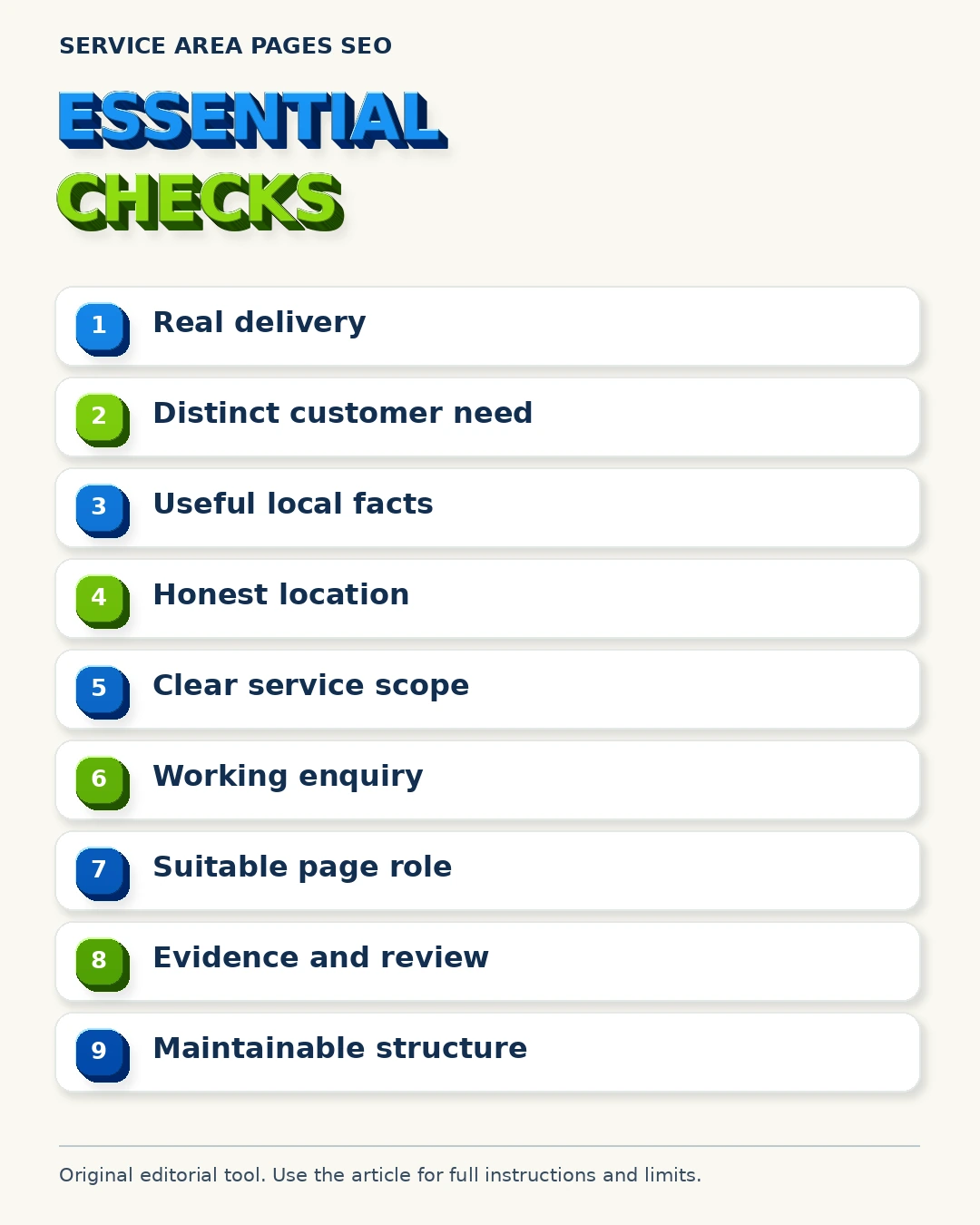
Before creating a new URL, answer the following questions with your operations team. If the business cannot confirm a fact, leave it out or investigate it. The objective is a useful destination customers can rely on, rather than a page for every possible suburb query.
1. Do you genuinely provide this service there?
Confirm the actual coverage and any conditions that change whether a job can be accepted. A business may serve an area for one type of work and not another. A general claim to cover an entire province may be less useful than an accurate explanation.
Record who can confirm coverage and when it was reviewed. Do not publish an invented travel radius because a template requests one. For remote services, explain the delivery arrangement rather than imitating a business that travels to customer premises.
Our local SEO guide for Mitchell’s Plain provides broader context for local discovery. A coverage decision still needs to reflect the particular business’s operations.
2. Is there a distinct customer need?
Ask what this page will answer that the main service page does not already answer adequately. The answer might involve genuine appointment arrangements, area-specific delivery conditions or a materially different service offering. It should be more substantial than changing a place name.
If the same service, process and conditions apply everywhere, a clear coverage section may serve customers well. You can still name the areas accurately within that section. A new URL is not automatically necessary for every place you serve.
Service area pages SEO planning becomes easier when each proposed page has a one-sentence purpose. If two purposes are effectively identical, consider whether the pages should be combined or the existing service page improved.
3. Which useful local facts can you verify?
Use facts relevant to the service. That might include appointment arrangements or a real delivery restriction. Do not add unrelated local history, generic weather paragraphs or landmark lists merely to lengthen the page.
If a condition can change, state how it will be confirmed during the enquiry. Avoid blanket response-time or availability promises unless the business can support them. Specificity should increase usefulness rather than create an obligation the business cannot meet.
Our guide to websites for trades shows how service scope and enquiry information can make a local page more practical without invented results.
4. Does the page describe your location honestly?
Distinguish “we serve customers in this area” from “we have an office here”. Do not create fake addresses, branch labels or staff profiles. A travelling business can be credible without pretending to have premises in every suburb.
For the profile itself, check Google’s business representation guidelines and service-area guidance. Those product rules should not be confused with a general entitlement to create more business profiles.
Our website and Business Profile consistency guide helps compare public information. Resolve differences that could leave customers unsure about where or how the business operates.
5. Is the actual service explained clearly?
An area page should still answer the buying questions for the service. Explain the work accepted, important scope limits and how the assessment begins. Do not assume the location name supplies the missing explanation.
Where a main service page contains more detail, provide a relevant link. The area page should nevertheless be useful as a landing destination. Sending every visitor elsewhere without answering their question weakens its purpose.
For example, a repairs business might explain which repair types it assesses and what information starts the conversation. It should avoid claiming every trade or emergency service simply to match a wider set of searches.
6. Can a customer make a useful enquiry?
Provide a working contact route and explain what to send. A suburb, service need and short description may be enough to begin. Request more detailed information only when it is necessary and appropriate.
Test the route on a phone and confirm delivery. A form that asks for a full technical diagnosis can discourage suitable customers or invite unsafe investigation. Staff should make the relevant assessment rather than require the customer to do specialist work.
Our AI search conversions guide separates visibility from useful business action. Apply the same distinction to local pages: a search appearance is not evidence that an enquiry arrived or was suitable.
7. Does the page have a clear role in the site?
Decide how the page relates to the main service explanation and coverage overview. Use relevant descriptive links. A local page should not exist as an isolated destination that nobody can reach through the website.
Google’s crawlable-link documentation explains normal link implementation. The content around the link should also help a person understand what they will find. Avoid filling unrelated pages with repetitive exact-match suburb anchors.
Service area pages SEO architecture should follow the services and places the business can genuinely support. There is no need to manufacture a complicated hierarchy for a small operation with a simple service offering.
8. Is the evidence honest and appropriately labelled?
If you have genuine photographs or customer evidence with permission, explain their context accurately. If you do not, use clear service information and useful process tools. Do not label a stock or AI-generated image as a project completed in the suburb.
An original enquiry checklist can be valuable without pretending to be field research. A hypothetical scenario can explain a decision when it is labelled. Our AI content SEO guide covers this factual distinction.
Avoid adding review or local-business markup that implies facts absent from the visible page. Our schema SEO service focuses on accurate implementation, not manufacturing local evidence.
9. Can the business maintain the information?
Every new page adds information to keep current. If coverage, service scope or contact routes change, identify all the pages affected. A large set of near-identical pages can become a maintenance problem as well as a content-quality problem.
Assign an owner and keep a simple inventory. Review the pages when operations change. Do not leave unsupported service claims live because the original content writer is no longer involved.
Our website maintenance service addresses ongoing care. The business must still confirm its own operational facts. A technical update does not automatically correct a changed service area.
Choose a page, section or branch destination
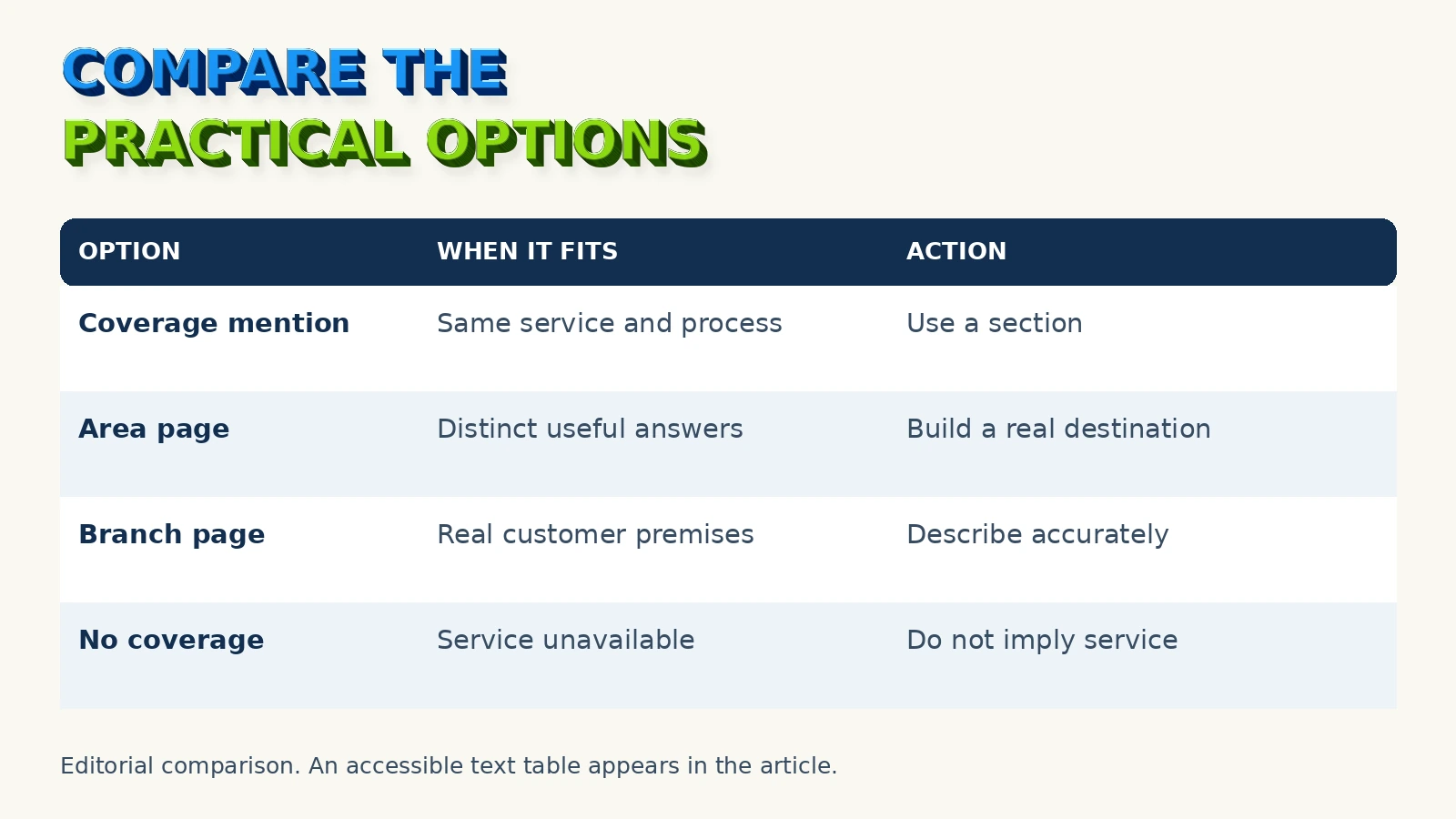
Use this decision table before commissioning more location content. It is a planning aid rather than a Google rule. A well-maintained coverage section can be a better customer experience than multiple thin pages with almost identical wording.
| Option | When it may fit | What the destination should do |
|---|---|---|
| Coverage section | Same service and process across nearby areas | State genuine coverage and link to the service and enquiry route |
| Dedicated area page | Distinct useful questions or arrangements | Explain those differences and provide a complete next step |
| Branch page | Real customer-facing business location | Describe the actual premises, services and visiting arrangements |
| No service claim | The business does not provide the service there | Avoid implying availability or an invented branch |
If an agency recommends hundreds of area pages, ask for the customer purpose and verified information for each group. A high page count does not establish quality. The business needs a credible reason to maintain the resulting content.
Google’s helpful-content guidance is a useful reference for that discussion. Ask whether a visitor would finish the page with the information needed, rather than needing to search again for the basic answer.
Use the coverage worksheet
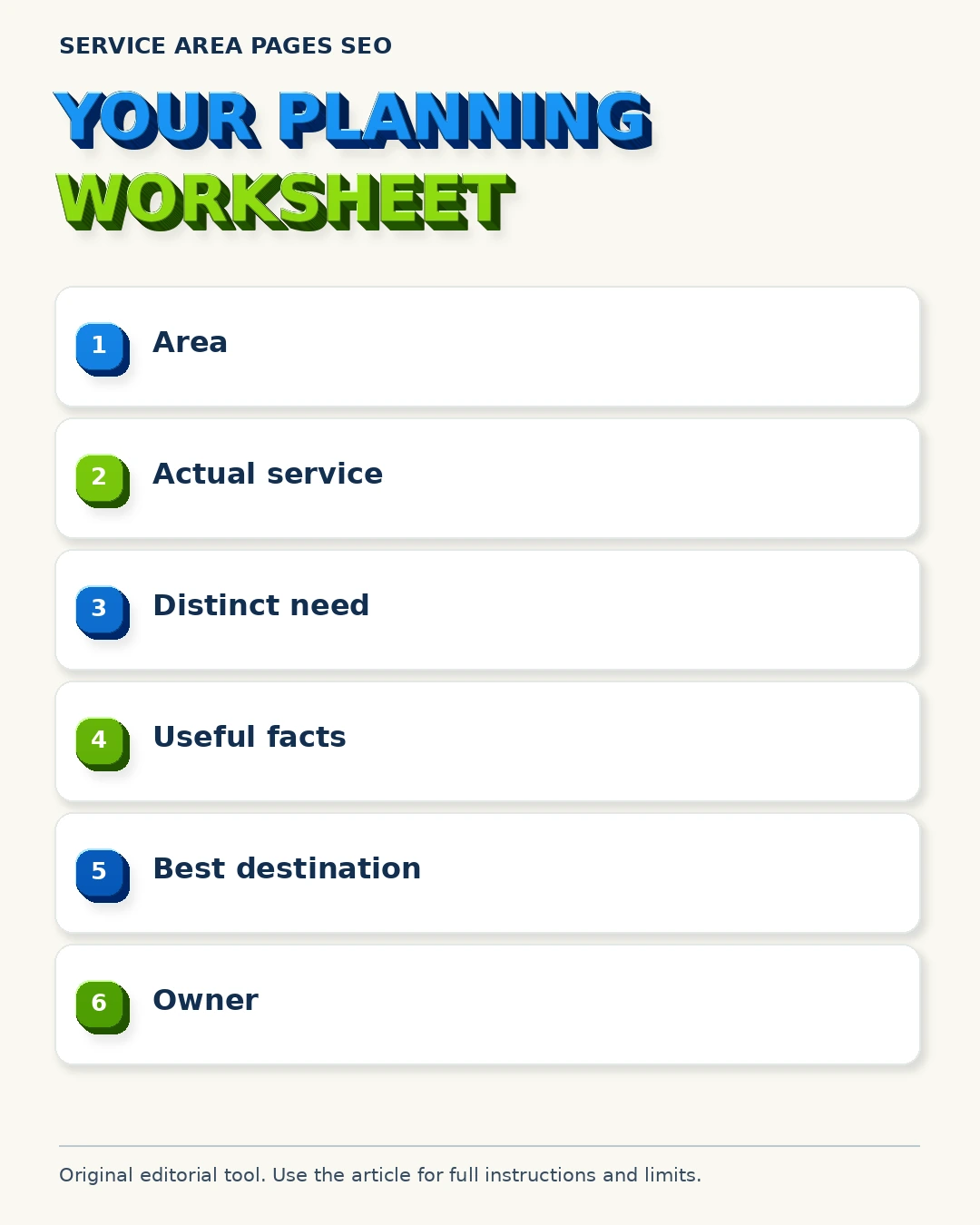
Complete this with someone who knows the actual work and scheduling arrangements. Do not let a keyword list decide service coverage. The website should describe the operation you have, not an imaginary network of local branches.
| Worksheet field | What to record |
|---|---|
| Area | The place customers recognise |
| Actual service | Which work is genuinely available there |
| Delivery arrangement | Remote, customer visit or business visit |
| Distinct customer need | What differs from the main service page |
| Useful verified facts | Relevant conditions or process information |
| Best destination | Coverage section, area page or real branch page |
| Evidence available | Owned material or accurate process details |
| Responsible person | Who confirms and maintains the information |
| Review trigger | Operational change that requires an update |
The worksheet should make weak page ideas visible before they are written. If the distinct-need field is empty, investigate whether a separate page is justified. Do not fill the gap with generic paragraphs about the suburb.
For a wider content structure, see our AI search optimisation guide. The same principle applies across search experiences: each page should contribute useful information to a real decision.
Build a useful website structure
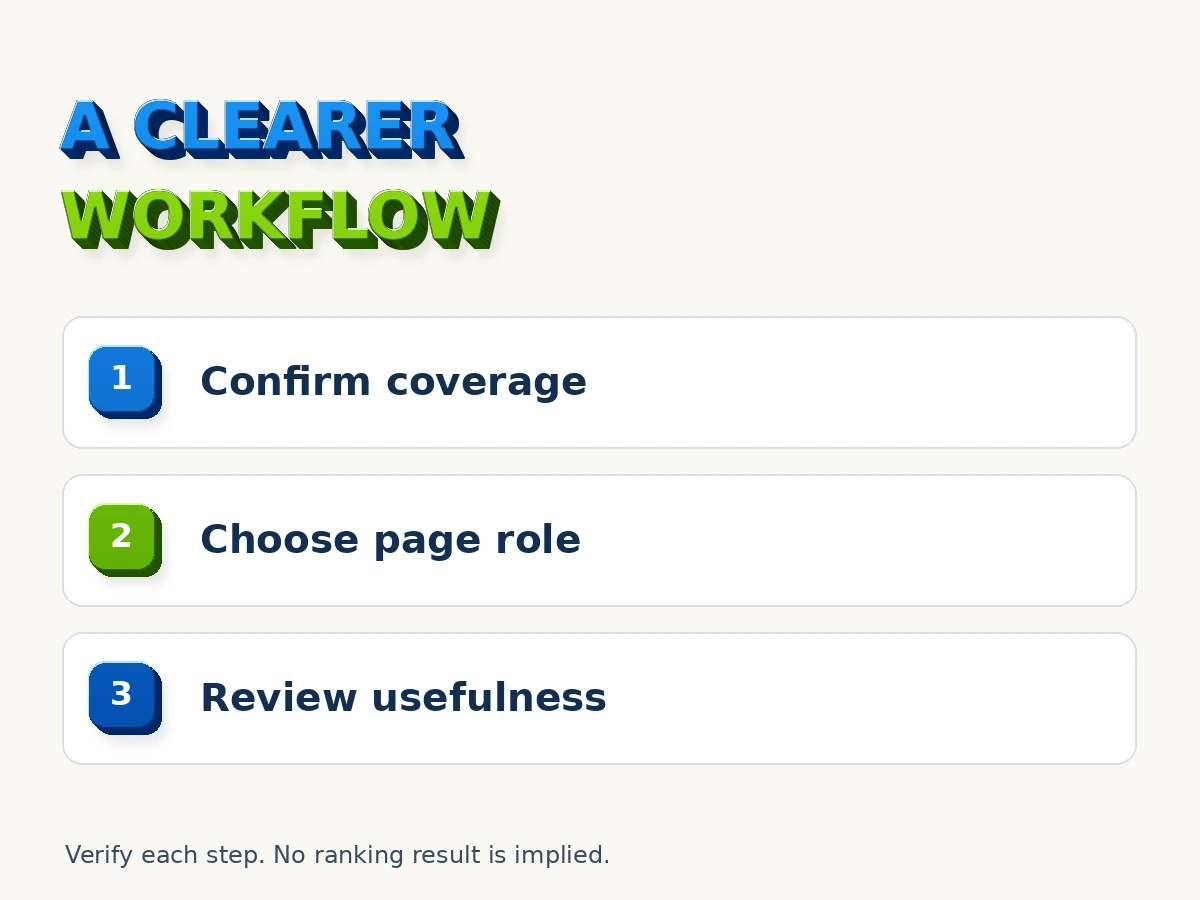
Begin with a strong main page for each important service. Add a coverage overview if customers need it. Create dedicated area pages where the worksheet supports them. Link between these destinations where it helps the reader understand service and coverage together.
Avoid using a massive footer list as the main reason location pages exist. Contextual links in the relevant service explanation usually give readers more information about why they should follow the link. Keep navigation proportionate to the website’s size.
Use accurate business information and appropriate structured data. Google’s LocalBusiness documentation describes supported markup, but it does not justify invented locations. The structured description must match the real business and visible page.
Our Google Business Profile SEO guide covers related local work. Website content, profile information and enquiry handling should support one another without being treated as interchangeable systems.
A hypothetical local-page decision
Fictional example: a Cape Town contractor offers the same assessment process across several nearby suburbs. The proposed pages differ only in the suburb name. There are no measured results or completed jobs in this example.
The owner completes the worksheet and finds no distinct local arrangements. A useful service page with a clear coverage section may be the stronger starting point. The contractor can explain accepted work and the information needed to assess an enquiry without creating multiple thin destinations.
Later, suppose the business establishes a real customer-facing workshop with different visiting arrangements. That creates a different information need. A factual location page may then be useful, subject to the actual operating setup and applicable profile requirements.
The lesson for service area pages SEO is to let verified customer information determine the page role. A location keyword can suggest a question to investigate. It cannot establish that the business has a meaningful local story to publish.
Review existing area pages before adding more
Inventory the current pages and compare purpose, service scope and coverage claims. Identify duplicates, outdated information and destinations that do not help a customer act. Use available reporting as evidence, with attention to its limits.
Do not delete or redirect pages solely because they mention locations. Some may be useful and have independent value. Where consolidation is appropriate, choose relevant destinations and update internal links carefully. Google’s redirect guidance provides the technical reference.
Measure what matters after improvements: working pages, discovery and suitable enquiries. Avoid claiming that a local-page rewrite caused growth based on a few searches or a short observation period. Record changes so later reviews have context.
If you need help prioritising the work, our SEO services can be discussed against the inventory. A service area pages SEO plan should justify its content before scaling production.
Frequently asked questions
Do I need a page for every suburb I serve?
No. Start with genuine coverage and the customer’s information needs. A coverage section may be enough when the service and process are the same. Create separate pages when they add useful, verifiable information.
Are all location pages doorway pages?
No. Evaluate purpose, content and implementation against Google’s spam policies. A genuine useful destination differs from similar pages created mainly to funnel visitors onward.
Can I create a branch page without a local office?
Do not imply premises or a branch that does not exist. Explain genuine service coverage honestly. Google Business Profile eligibility is a separate question governed by its own guidelines.
What if I have no local case studies?
Use accurate service scope, process information and practical enquiry guidance. Label hypothetical scenarios and editorial illustrations. Do not invent work, reviews or local staff.
Will adding suburbs improve map rankings?
There is no guarantee. Google’s local-ranking guidance describes relevance, distance and prominence. Website wording alone does not control those systems or create new premises.
Plan your real coverage before writing more pages
Contact Easy Rank with your website, services and actual coverage. We can discuss whether the next useful step is a better service page, a coverage section or a distinct local destination.
About the author

David Gous is the founder of Easy Rank in Cape Town, working on website design, SEO and AI search visibility. This article provides an original service-area decision worksheet based on primary guidance. It does not claim client rankings or completed local projects.