 Skip to content

Google AI Official Sources: 9 Essential Website Checks
By David Gous · · 12 min read
Google AI official sources are in the news because Google announced a test that highlights official links for specific tasks in its AI search experiences. For a South African business, the useful response is to make the right page easy to identify, trust and use. There is no published application process in that announcement for a local-business badge and no promised placement.
This guide gives you a nine-check worksheet for your own website. It focuses on the pages customers need when they want to request a quotation, confirm a service, book an appointment or find your real contact details. You can apply it before you have case studies, testimonials or a large content library.
Checked: 18 October 2026. The official-link display is an announced test. The announcement does not confirm South African availability. The examples and worksheet below are Easy Rank’s editorial recommendations, not Google’s eligibility rules.
In this guide
What Google actually announced
In its 15 October Search announcement, Google described a test for tasks where one or two official web destinations are especially relevant. It also announced more prominent links in AI answers and changes to article discovery. The important distinction is between an announced experiment and a feature every business can obtain.
The Google AI official sources test does not establish a new certification that an agency can sell. It does not say that adding a particular file, schema field or phrase makes a website an official source. A screenshot from one search is also insufficient evidence that a display is available for every user, query or country.
Our interpretation is practical: businesses should maintain accurate destinations for the customer actions they control. If someone wants to contact your company, your own contact page should be clear about how to do that. This remains useful whether an AI display changes or stays the same.
For the wider picture, read our guide to Google AI Overviews in South Africa. Treat the specific interface announcement separately from broader claims about ranking updates.
What an official source means for a small business

Your business is the primary source for its own current services, accepted work, booking process and contact arrangements. It is not automatically the primary authority for every topic related to its industry. A plumbing company can explain which jobs it accepts. It should not imply that it replaces the relevant regulator when discussing registration requirements.
That distinction helps you choose useful content. A general paragraph about how important customer service is adds little to a person trying to arrange a visit. A clear explanation of what information to send, which areas you serve and what happens after an enquiry gives that person something they can use.
Start with the pages closest to a real decision. For most service businesses, those include the core service page, contact page, about page and any genuine booking or quotation route. A blog can explain the process and link to those destinations, but the practical information should also be available where the customer acts.
This is one part of entity SEO in South Africa: making the business and its relationships understandable through accurate, consistent information. It does not require pretending to be a larger organisation or manufacturing evidence you do not have.
Nine checks for Google AI official sources preparation
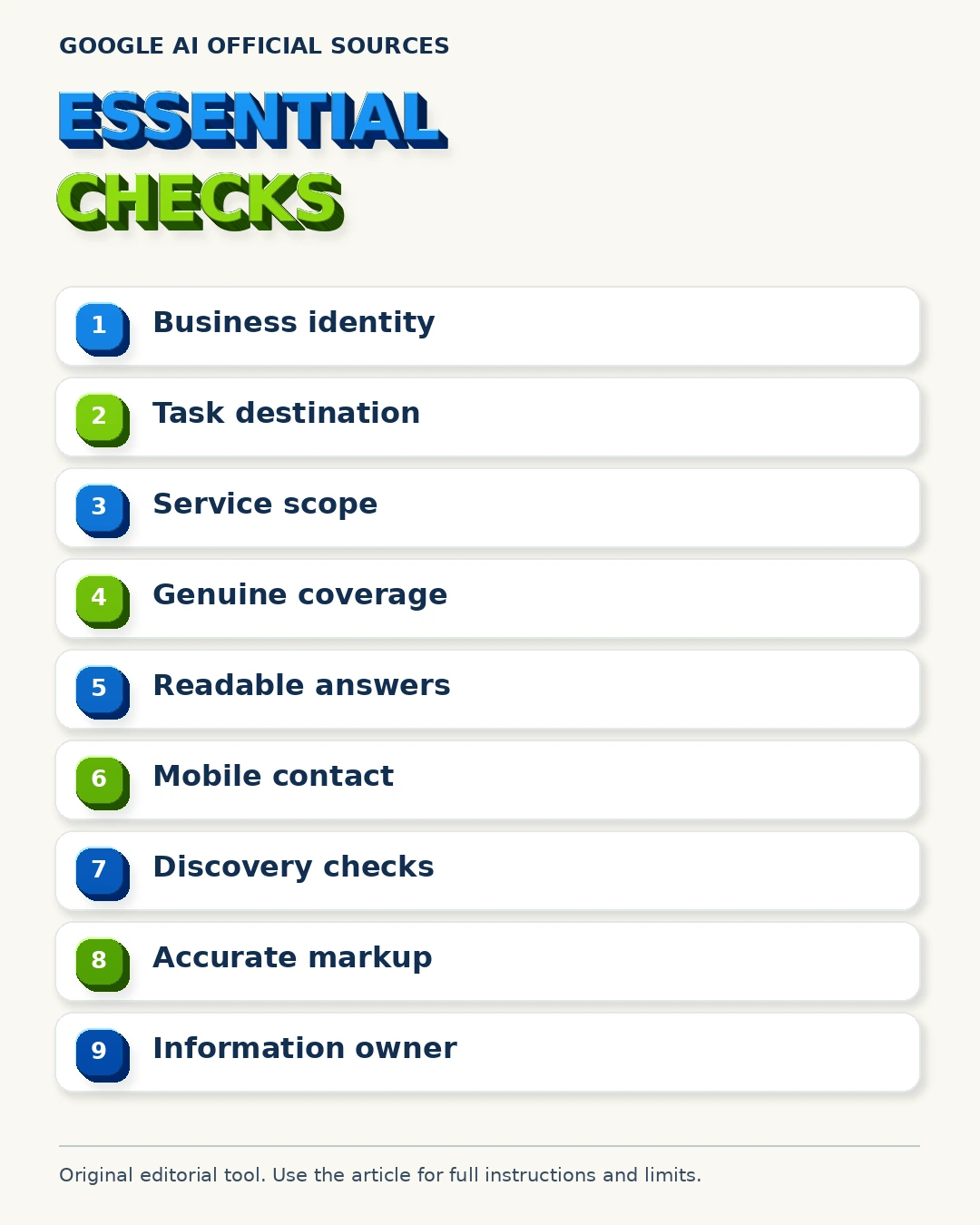
Use these checks as a customer-service review. Mark each item clear, needs work or not applicable. Do not add them into a supposed Google score. The aim is to find the first obstacle between a genuine question and a useful answer.
1. Name the business behind the page
Read the page without your logo or navigation. Can a visitor tell which business is responsible for the service? Include the trading name naturally where it helps understanding. An about page should identify the people or organisation behind the website without exaggerated credentials.
Also compare your website name, public business profiles and email signature. A legitimate trading-name difference can be explained. Unexplained inconsistencies leave customers guessing. Our guide to website and Google Business Profile consistency gives you a separate review for those details.
2. Give each important task a clear destination
Choose the best URL for each action: request a quotation, book, contact support or view service coverage. Link to that destination consistently. Avoid sending visitors through a blog post, then an empty shop page, then a generic form when one direct route would do.
If your contact button says “Request a proposal”, the next page should explain what information starts a proposal. The button label and destination should describe the same action. You can test this in an ordinary browser without specialist software.
3. State what the service includes
Describe the work the business actually accepts. Add important boundaries where they affect a buying decision. For a website project, that might mean explaining whether content entry, hosting setup or ongoing updates are included in the agreed scope.
Do not publish unconfirmed delivery promises to make a page sound more complete. If price and timing depend on an assessment, explain the assessment. Our AI-ready WordPress website service is a relevant destination when your question concerns website requirements rather than an AI-search display.
4. Explain genuine geographical coverage
Tell people where the business can deliver the advertised service and whether the arrangement is remote, at your premises or at the customer’s location. A service-area statement should reflect operations. It should not imply branches or staffed offices that do not exist.
For a travelling business, the enquiry may need a suburb before an appointment can be discussed. For a remote service, the relevant information may be availability and how the work is delivered. Our Google Business Profile SEO guide covers the profile side of local information.
5. Keep important answers in readable page text
A poster image can support a page, but it should not be the only place containing your contact number, service conditions or opening arrangements. Put essential information into readable text and use a logical heading structure.
This improves access for visitors who enlarge text, use assistive technology or have difficulty reading small text inside an image. It also makes the information easier to maintain. Our AI website builder SEO guide explains why a polished first impression still needs working page content.
6. Make the next step work on a phone
Open the page on a small screen. Follow the actual contact route. Confirm that the form labels make sense, required fields are reasonable and the confirmation explains what happens next. Test delivery using a clearly labelled test submission, then check the inbox or lead system that should receive it.
A button click is not proof that an enquiry arrived. A functioning process includes the destination, delivery and a way for the business to respond. Keep sensitive information out of unnecessary form fields.
7. Check discovery and indexing separately
Ask your website manager to check that important public pages are accessible, internally linked and appropriate for indexing. Google’s crawlable-link guidance explains the normal link format used for discovery. A visual button without a working destination is not an adequate substitute.
Where you have access, use Search Console to inspect the actual task URL. A sitemap entry helps discovery but does not prove indexing. Avoid using a single site search as your only diagnostic. Google’s recrawl documentation describes the available request routes without promising immediate inclusion.
8. Use accurate supporting markup
Structured data should agree with the visible page. It should describe the real business and the content that exists. Do not add invented awards, ratings, branches or services because a generator offers those fields.
Read Google’s structured-data policies before accepting claims about special markup. Our schema SEO service concerns accurate implementation and validation. Schema is not a way to buy entry into the Google AI official sources test.
9. Assign an owner to changing information
Write down who updates contact routes, service descriptions and availability. Give that person a simple change log. A technically sound page becomes misleading if the business changes and nobody updates it.
A useful log records the changed fact, the affected URLs, the person responsible and the date it was checked. Include public profiles when relevant. Our website maintenance service supports the ongoing care that keeps a website usable after launch.
Compare a vague page with a useful task page
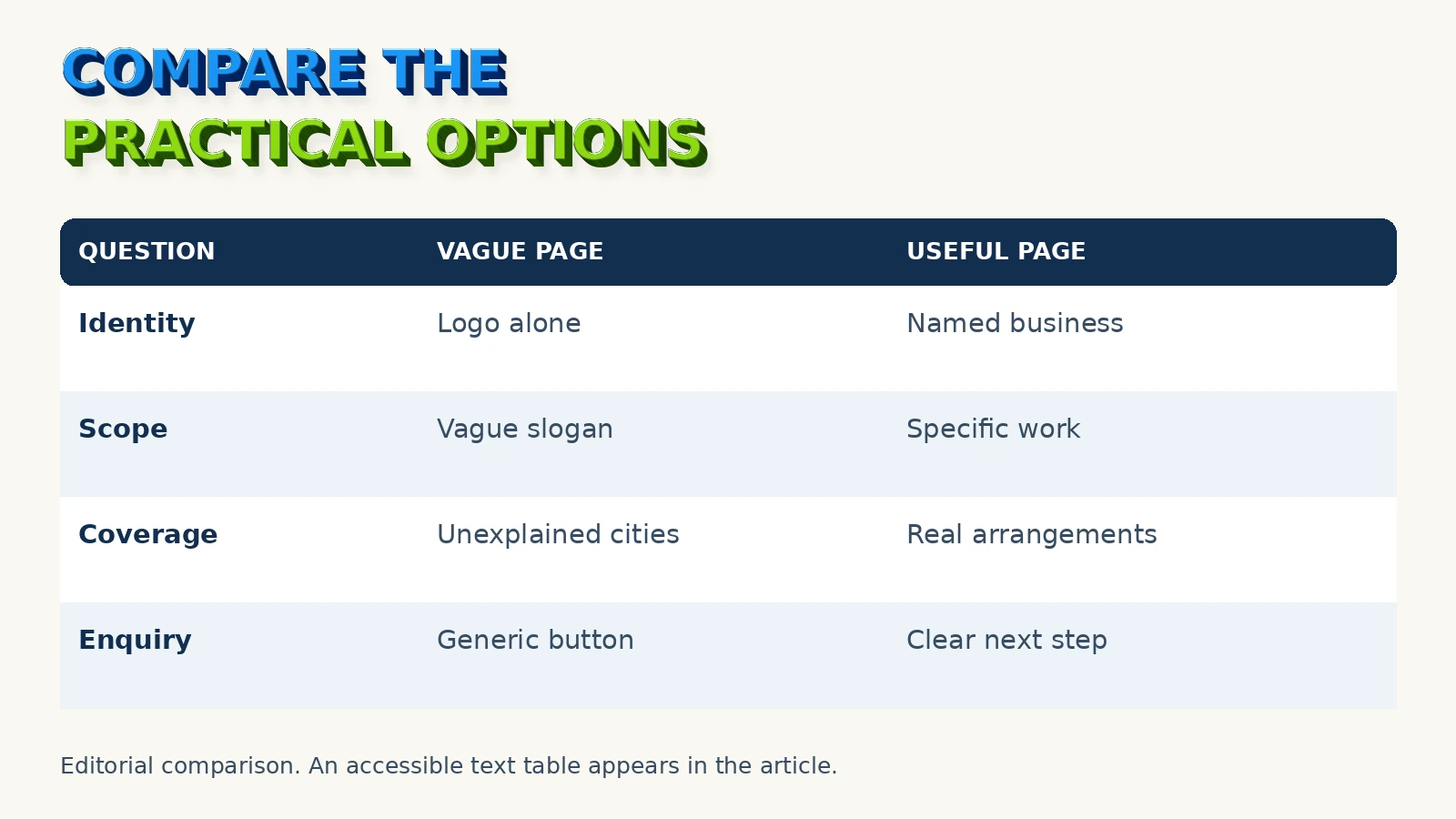
The following table is an editorial comparison. It is not a ranking experiment or a claim about Google’s preferred design. Use the right-hand column to identify information that would help your own customers act with fewer assumptions.
| Customer question | Vague page | More useful task page |
|---|---|---|
| Who provides this? | A logo with no explanation | Named business and relevant about link |
| Is this the right service? | “We do everything” | Specific work, scope and important exclusions |
| Can you help in my area? | An unexplained list of cities | Genuine coverage and delivery arrangement |
| What should I send? | “Contact us today” | A short list of useful enquiry details |
| What happens next? | No process explanation | The next assessment or response step |
| Is the information current? | Conflicting old details | Consistent information with an assigned owner |
Do not rewrite every sentence on the site at once. Begin with one high-value task and make its route complete. Preserve useful existing URLs and information while you remove friction.
A worked example without invented results
Hypothetical example: a Cape Town repairs business receives vague messages asking whether it can help. Its service page says “Professional property solutions” and the contact form asks only for a name and phone number. There are no measured outcomes in this example.
A useful rewrite could be: “Tell us the suburb, the type of repair and a short description of the problem. We will confirm whether the work is within our service scope and explain the next assessment step.” The business would need to adjust that wording to match its real process.
This rewrite does three jobs. It helps the visitor decide whether to enquire, helps staff assess the request and makes the advertised next step explicit. It does not make a promise about response speed or imply that all jobs will be accepted.
The corresponding page would also name the actual services and coverage. If the business has no project photographs yet, it can explain its process honestly. Editorial illustrations should be labelled as illustrations and should never be presented as completed customer work.
For a more specific website structure, our guide to websites for trades in Mitchell’s Plain covers service and enquiry information for local trades businesses.
Build your customer-task worksheet
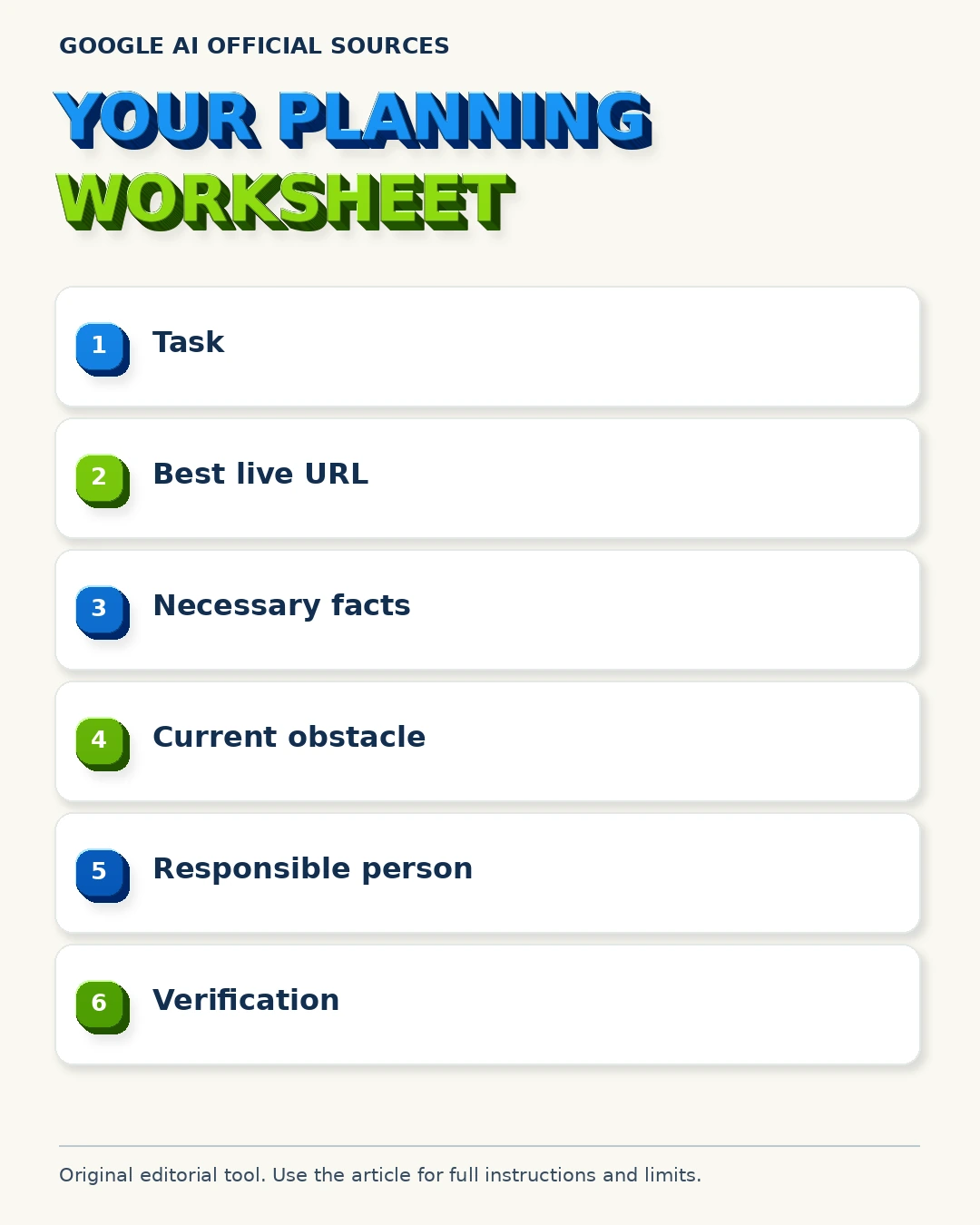
Create one row for each important customer action. The worksheet is most useful when the business owner and the person maintaining the website complete it together. Neither needs to speculate about how an AI model scores the company.
| Field | What to record |
|---|---|
| Customer task | The action or exact information the person needs |
| Best destination | The single most appropriate live URL |
| Necessary facts | Scope, coverage, requirements and next step |
| Evidence available | Real process details, documents or owned material |
| Current obstacle | Missing answer, broken route or inconsistent detail |
| Responsible person | Who can confirm and maintain the information |
| Verification | How you will check the change works |
Choose the row with the clearest customer benefit first. A broken quotation route usually deserves attention before a speculative AI-specific file. Record the existing wording before changing it so you can compare the result and reverse an unhelpful edit.
If your Google AI official sources preparation becomes a long list of technical purchases with no connection to a customer task, return to this worksheet. Every proposed change should have a reason a visitor or website operator can understand.
What to measure after improvements
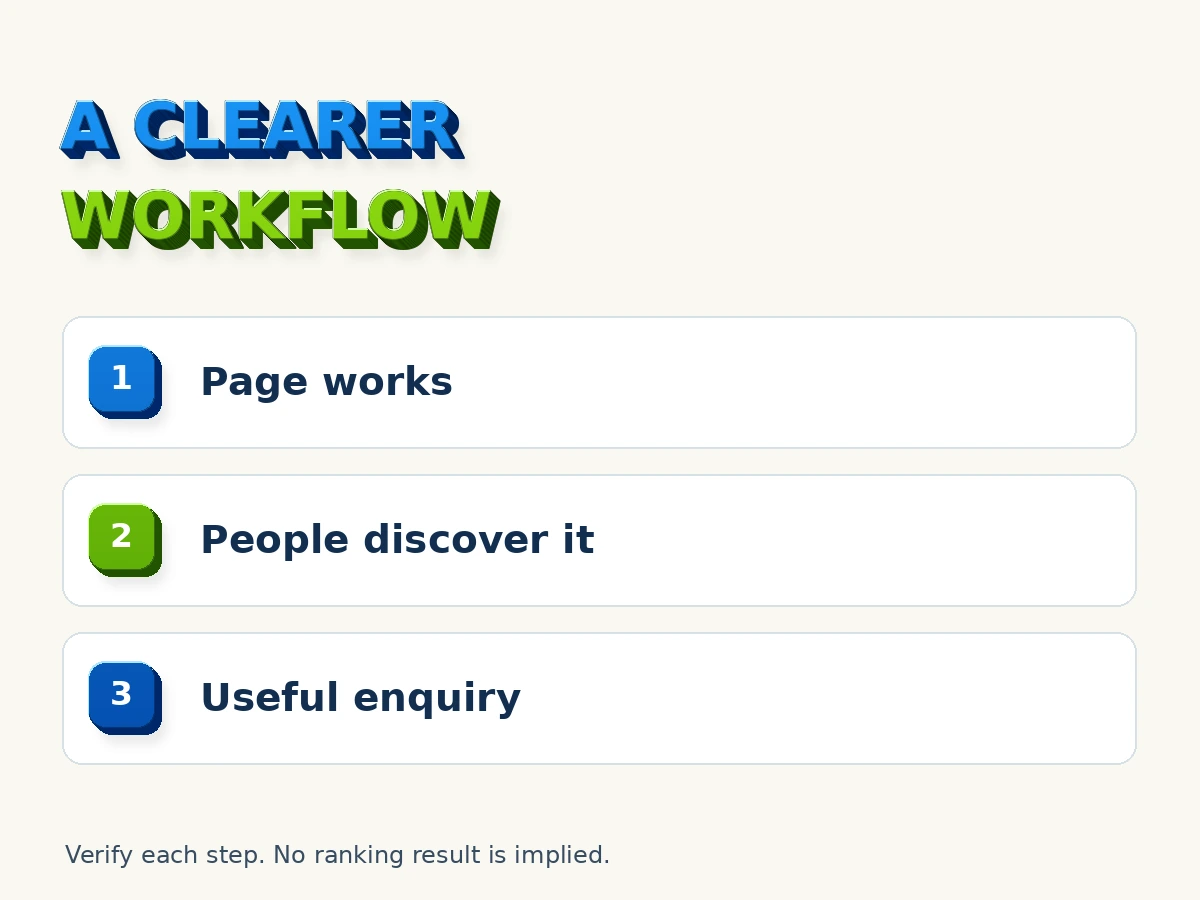
Keep three kinds of evidence separate: whether the page works, whether people discover it and whether useful enquiries result. A pass in one category does not establish the others. A working page can have little traffic. A visible page can attract unsuitable enquiries.
Record the date of the change and the exact URL. Check whether the route still works on mobile. Review relevant search reporting where available and compare comparable periods with care. A small sample or changing search interface makes strong causal claims unreliable.
For AI visibility observations, record the query, date, location context and the actual cited URL. A business-name mention without a link is different from a citation to the service page. A citation is different from a qualified lead.
An official citation can still point to an earlier event; our 2026 municipal election source audit shows why the election year and legal procedure need separate checks.
Our guides to AI visibility measurement and AI search conversions in South Africa explain those distinctions. Do not report an “official source” win unless you can document what actually appeared.
What to avoid while the test develops
Avoid buying a guaranteed official-source placement, adding fake reviews or publishing many near-identical pages for every possible query. These actions do not create a useful customer destination. They can also make your information harder to maintain.
There is no need to describe ordinary website maintenance as a secret optimisation method. Google’s AI search guidance keeps conventional SEO relevant and rejects several supposed special requirements. Use the documentation when evaluating a supplier’s recommendation.
The Google AI official sources announcement is a reason to review the clarity of your own destinations. It is not a reason to abandon a sensible content plan or replace all your service pages overnight. Keep the useful work even if the interface test changes.
Frequently asked questions
Can a South African business apply for Google AI official sources?
The 15 October announcement does not provide a local-business application process for this test. It also does not confirm South African availability. Be careful with suppliers selling access that they cannot substantiate.
Do I need case studies before improving these pages?
No. You can publish accurate service scope, coverage, process information and practical tools without claiming customer results. Add genuine case studies later when you have permission and evidence. Do not present an invented example as a completed project.
Will these checks guarantee a citation or ranking?
No. They improve the usefulness and maintainability of your website. Search systems decide what to crawl, index and show. No checklist can guarantee a placement in an experimental display.
Does schema make my business an official source?
There is no such eligibility promise in the announcement. Accurate schema can support the wider website implementation, but it should match the visible content and real business details.
Which page should I improve first?
Choose the page tied to a valuable customer task with an observable problem. A service page with unclear scope or a contact route that fails is a practical starting point. Use the worksheet to keep the decision specific.
Request a practical website review
If you want help finding the first useful improvement, contact Easy Rank with your website address, the service you want to promote and the customer action that matters most. We can discuss the appropriate scope before recommending work.
About the author

David Gous is the founder of Easy Rank, a Cape Town business working on website design, SEO and AI search visibility. This article combines current primary-source research with an original customer-task worksheet. It does not claim client results or Google endorsement.