 Skip to content

AI SEO Proposal: 9 Essential Questions for SA Businesses
By David Gous · · 11 min read
An AI SEO proposal should explain the business problem, the pages and systems involved, the work you will receive and how that work will be checked. For a South African business, the most useful comparison is between clear deliverables and responsibilities. A promise to “rank in AI” is not enough to define a project.
For a sector-specific scope, our lawyer marketing Cape Town service identifies the practice-area, approval and enquiry responsibilities a firm should discuss before accepting a proposal.
This guide gives you nine questions to ask before choosing an AI SEO agency, a comparison table and a scope worksheet. It is useful even when you have no case studies and are still building the evidence around your business. You can evaluate a proposed process without accepting invented results or guaranteed placements.
Research checked: 18 October 2026. The examples are fictional buying scenarios. Easy Rank’s worksheet is an editorial tool, not a Google or AI-platform scoring system.
In this guide
What an AI SEO proposal should mean

AI search visibility work can include conventional SEO, clearer service content, technical fixes, structured data, business information and measurement. The label alone does not tell you which of these is included. Two suppliers using the same label may be proposing very different work.
Ask the supplier to connect each activity to a specific business need. If customers cannot understand your service, content clarification may be appropriate. If the relevant page is blocked from indexing, another batch of articles does not fix that obstruction. If enquiries are not recorded, reporting needs attention before anyone claims growth.
Google’s guide to hiring an SEO is a useful starting point for evaluating suppliers. It encourages informed questions about recommendations and risks. Apply the same scrutiny when the proposal adds AEO, GEO or AI visibility terminology.
For definitions, our guides to what AI SEO means and what AI visibility means can help. Keep the buying conversation centred on work that improves the business’s actual website and customer journey.
Nine questions every AI SEO proposal should answer
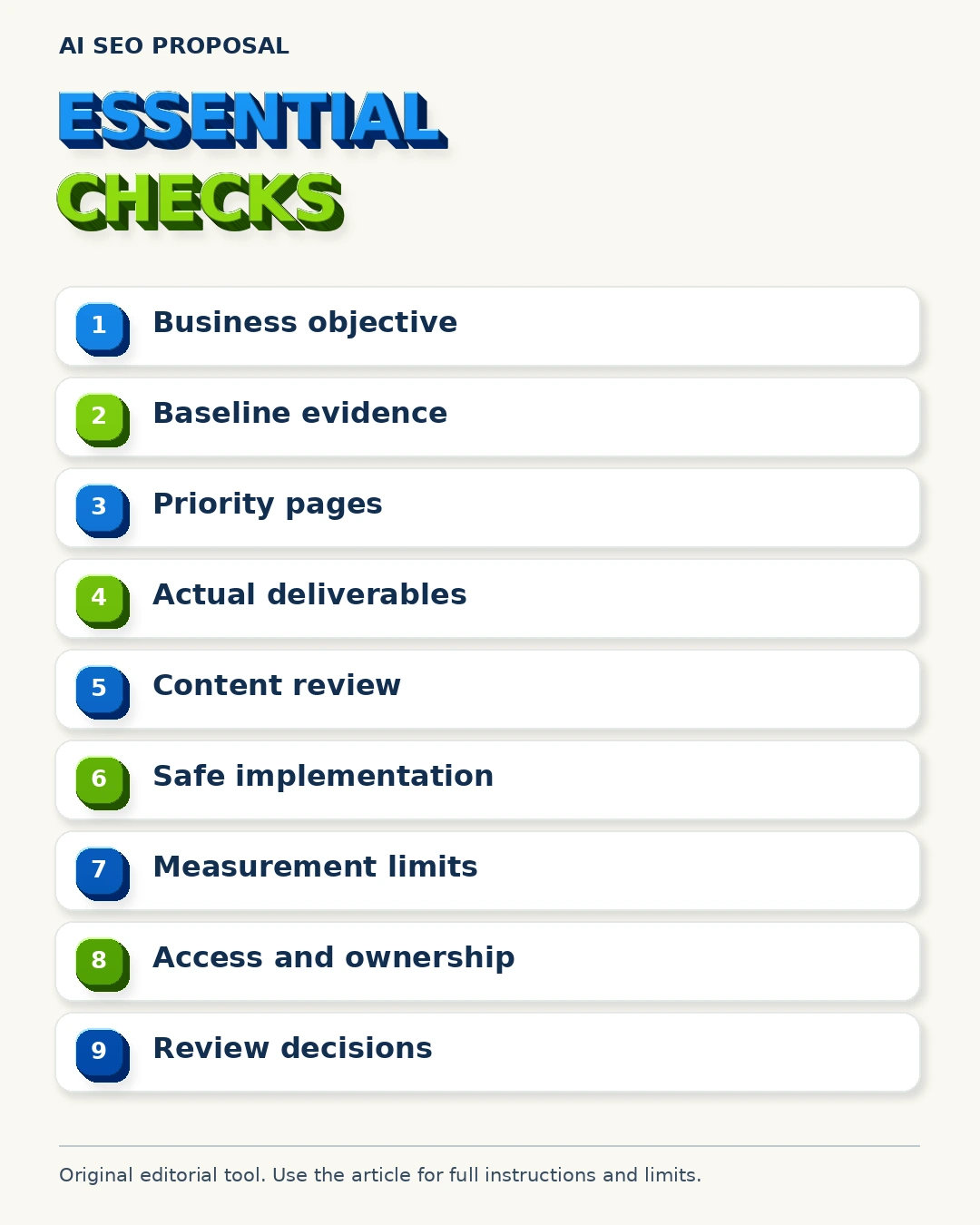
Use these questions in a meeting or send them to the supplier in writing. A useful answer names the deliverable, the evidence and the responsible person. If the answer depends on access or further investigation, that dependency should be explicit.
1. Which business objective does this work support?
Ask which service, customer group and action the proposal prioritises. “More visibility” is incomplete. A business may need more suitable quotation requests for one service, clearer information before booking or better discovery of an existing product range.
Record the objective in language the owner can recognise. Do not let a platform-specific score replace it. A narrower initial objective often makes scope and reporting more useful because the team knows which pages and enquiries deserve attention.
Our AI SEO for small businesses service is relevant when the challenge is prioritising a limited set of improvements. The appropriate work still depends on the business and evidence available.
2. What baseline evidence do you have?
Ask which URLs were reviewed, which reports were available and which assumptions remain unverified. A public-site review can identify visible problems. It cannot establish your private conversion rate or the quality of enquiries arriving in your inbox.
Where an agency uses AI-search observations, request the prompts, dates, platform and cited URLs. A small prompt sample is not a complete view of a market. It can identify questions for further investigation when its limits are clear.
Our AI visibility measurement guide explains why a citation, mention and business enquiry need separate treatment. A proposal should preserve those distinctions rather than combine them into an unexplained success number.
3. Which pages will be prioritised, and why?
Ask for a short list of intended page roles: service explanation, buying guide, location information or contact destination. The supplier should explain whether an existing page should be improved before another page is created.
This protects against unnecessary overlap. If your site already has a useful guide answering the same question, a second similar article may divide maintenance effort without adding value. Ask what new information the proposed content will contribute.
For an existing WordPress website, our AI SEO for WordPress page describes the relevant service area. The proposal should still identify your actual pages rather than rely on a platform label.
4. What will I receive at the end of the work?
Separate recommendations from implementation. An audit document, a repaired form, a rewritten service page and a tracking configuration are different deliverables. A proposal should make clear which are included and which require a separate decision or budget.
For each deliverable, agree on an acceptance check. A rewritten page can be checked against the approved facts and brief. A technical fix needs an appropriate functional test. A reporting setup needs a clear definition of the data it captures.
Avoid treating an activity count as the whole value proposition. Ten articles do not automatically address ten useful customer needs. Ten technical recommendations do not mean ten fixes have been implemented. The scope should describe the result of the work itself.
5. How will business facts and AI-assisted content be reviewed?
Ask who confirms services, coverage, prices where published, qualifications and process details. The business remains the source for its own facts. A writing tool cannot verify what the company actually delivers or whether a named person holds a credential.
If case studies do not exist, the proposal should use accurate process information, practical worksheets and clearly labelled examples. It should never manufacture clients, testimonials, performance figures or first-hand experience.
Google’s guidance on generative AI content provides the relevant quality context. Our AI content SEO guide covers the business-side review. Ask for a factual sign-off step before publication.
6. How will changes be implemented and checked?
Ask who edits the website, which systems they will touch and what evidence confirms a change works. Clarify backup and recovery arrangements for meaningful technical changes. A recommendation to change URLs, for example, needs more care than correcting a typo.
Keep access proportionate to the agreed work. Do not hand over every account simply because a generic onboarding form requests it. The supplier should explain the access needed and how the business retains control.
If markup is proposed, ask which visible information it describes and how it will be validated. Google’s structured-data policies and our schema SEO service are useful references for that discussion.
7. What will the report prove, and what will it not prove?
Ask the supplier to distinguish completed work, observed visibility, website activity and qualified enquiries. A report can show that a page was improved without proving that the edit caused a subsequent sales increase. Several things can change at the same time.
Where search reporting is available, ask which property and report will be used. Where analytics events are involved, ask what each event means. A click to open a contact form should not silently become a confirmed lead in the report.
Search Console’s performance documentation explains the relevant search metrics. Our AI search conversions guide helps connect visibility discussions with business evidence while preserving attribution limits.
8. Who controls accounts, content and ongoing costs?
Ask about business access to the domain, hosting, WordPress, analytics and important profiles. Clarify which software licences are included, who pays renewals and what happens when the relationship ends. Record the arrangement before it becomes urgent.
The proposal should also explain whether content and website changes remain available to the business after the engagement. If a subscription supplies a feature, identify that dependency. Avoid assuming that all ongoing costs are included in the SEO fee.
Our website maintenance service covers a different category of work from a search campaign. A proposal can include both, but it should make the responsibilities understandable rather than hide them under one label.
9. Which decision follows the first review?
Ask what would justify continuing, changing priorities or stopping a particular activity. A useful review connects evidence to the next action. It should not simply renew the same deliverables regardless of what the business learns.
For a project, define completion and any follow-up period. For ongoing work, define how priorities are chosen and approved. Neither format should rely on guaranteed rankings as the acceptance criterion.
An AI SEO proposal becomes more useful when it names the next decision as well as the next task. The business can then assess whether continued work addresses an identified need instead of paying indefinitely for an unexplained process.
Compare promises with deliverables
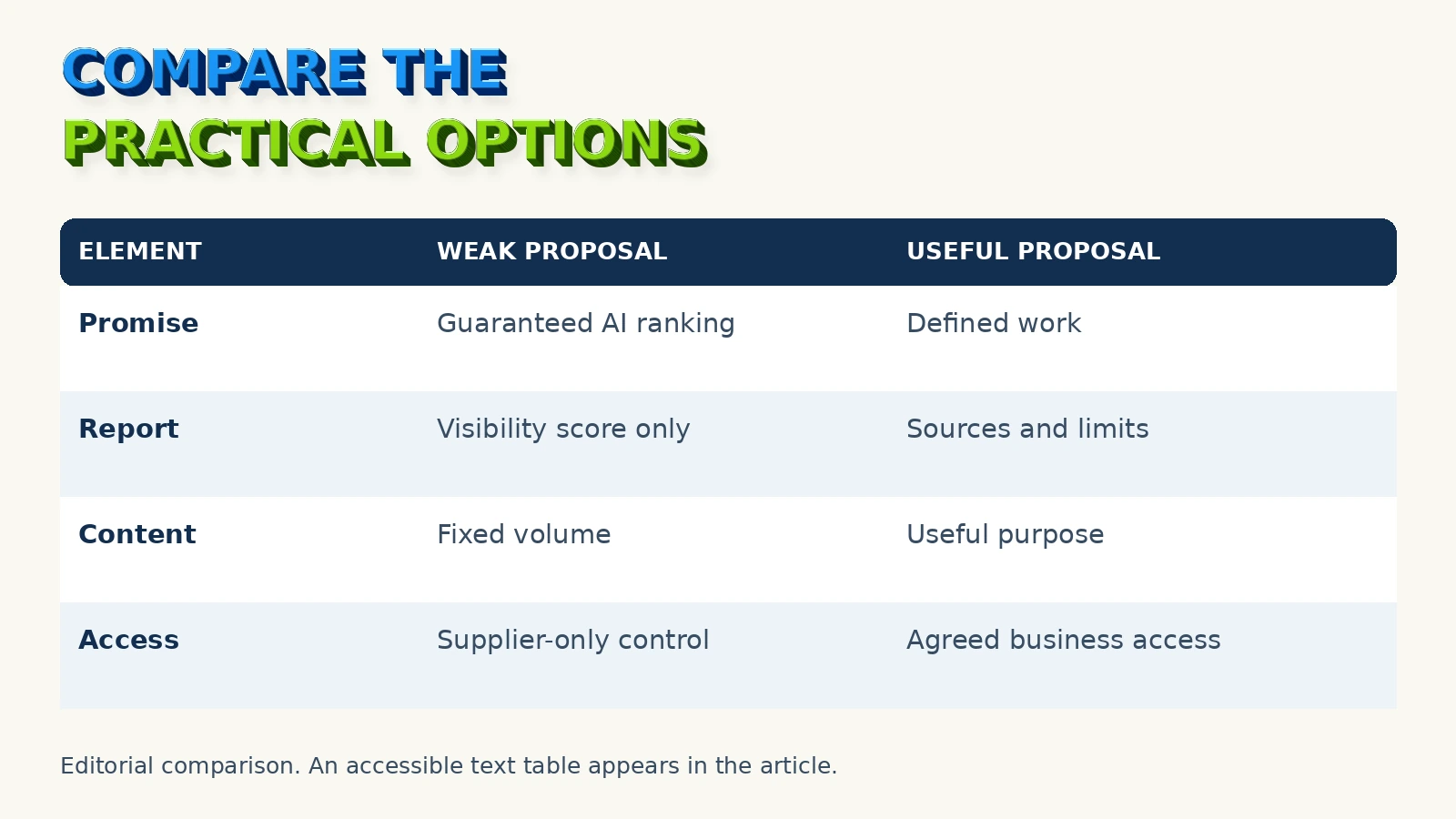
Use the following table to identify questions for a supplier. It does not tell you which agency to choose. A short proposal can be useful if its scope is clear, while a polished document can still leave the important responsibilities undefined.
| Proposal element | Weak explanation | More useful explanation |
|---|---|---|
| Objective | “Dominate AI search” | A named service, audience and customer action |
| Baseline | One unexplained visibility score | Reviewed URLs, sources, dates and limitations |
| Content | A fixed article count | Intended page roles and factual review |
| Implementation | “Technical SEO included” | Named fixes, responsible person and checks |
| Reporting | Rankings and mentions combined | Work, visibility, activity and enquiries separated |
| Ownership | Supplier-only access | Agreed business access and documented dependencies |
| Review | Automatic repetition | Evidence linked to the next work decision |
No supplier controls an AI platform’s selection of sources. Be careful when a sales claim depends on access to a secret ranking system or an exclusive submission method that cannot be supported by official documentation.
Google’s current AI-search guidance keeps established SEO relevant and addresses several supposed special requirements. Use the primary documentation to test a claim before paying for an unnecessary feature.
Build your AI SEO proposal worksheet
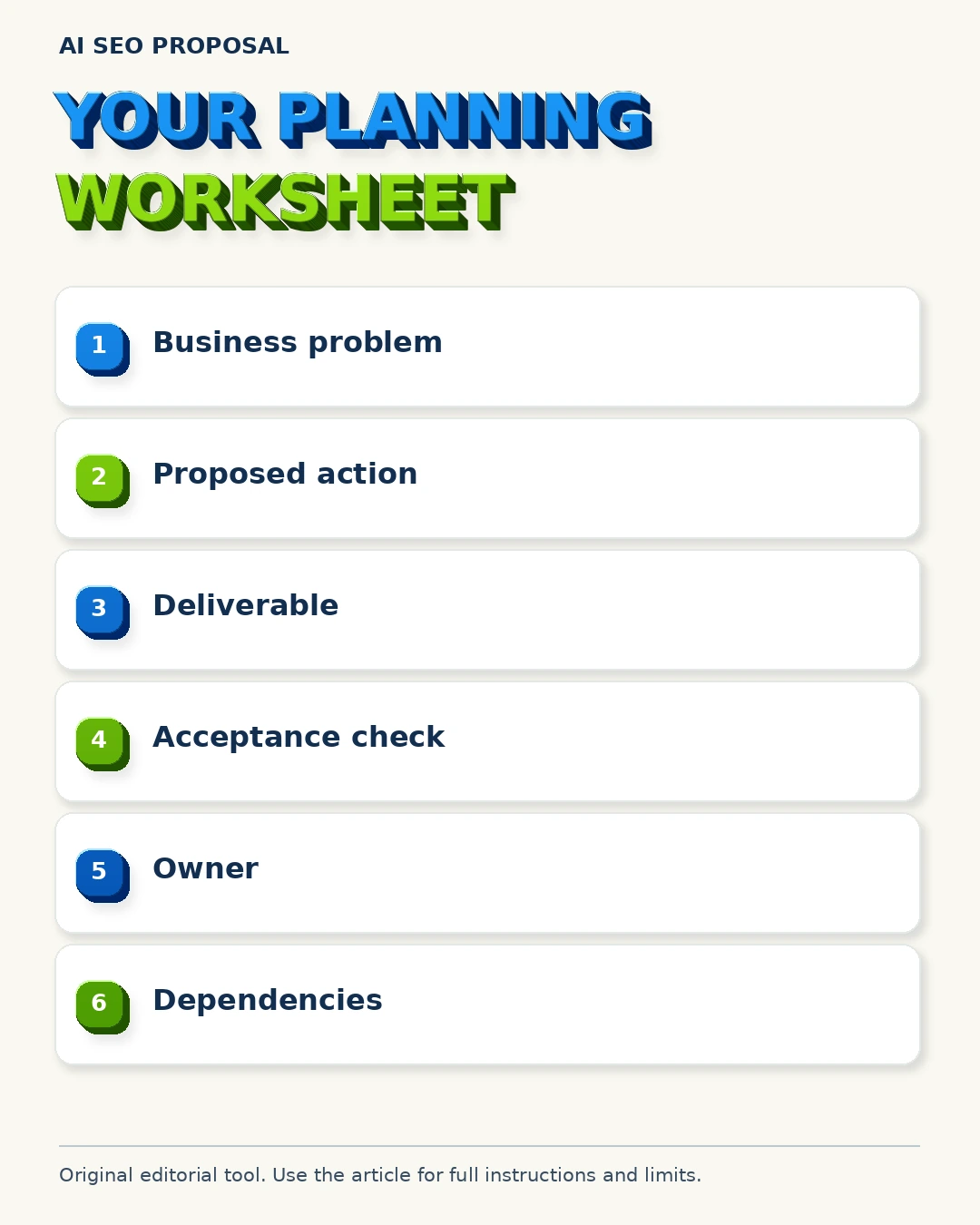
Create one row per proposed deliverable. Send the same worksheet to each shortlisted supplier so that you compare equivalent information. Leave uncertain fields visibly unresolved rather than filling them with assumptions.
| Field | Question to answer |
|---|---|
| Business problem | What specific obstacle are we addressing? |
| Evidence | Which page, report or observation shows it? |
| Proposed action | What will change? |
| Deliverable | What will the business receive? |
| Acceptance check | How will completion be verified? |
| Responsible person | Who implements and who confirms facts? |
| Dependencies | Which access, content or outside work is required? |
| Reporting limit | What can this measurement actually establish? |
| Review decision | What will we decide after the first review? |
This worksheet also helps distinguish price differences. One proposal may include implementation and another may supply advice only. Comparing totals without that distinction can make a cheaper proposal appear equivalent when it leaves substantial work with your team.
For the wider scope discussion, review our AI SEO pricing information. Ask for a proposal based on the actual requirements. Do not assume that a public example or another business’s package defines your project.
What to do when your business has no case studies
Tell the supplier early. Ask for an evidence-building content plan that starts with facts you can substantiate now. Service scope, how a project starts, what customers should prepare and how decisions are made can all be useful without a history of published outcomes.
Use original tools where you can add practical value. A comparison worksheet, enquiry checklist or decision table gives readers something concrete. Explain its purpose and limits. Do not describe an editorial score as a measured industry benchmark.
Label hypothetical scenarios clearly. Use AI-generated scenes as editorial illustrations rather than photographs of your own team or completed work. If genuine customer evidence becomes available later, obtain the appropriate permission and document how any result was measured.
The AI SEO proposal should recognise this starting point. A supplier who insists on filling the gap with made-up testimonials or impressive-looking numbers is proposing content the business cannot responsibly support.
A hypothetical proposal comparison
Fictional example: a service business receives two proposals. One promises twenty articles and “AI dominance”. The other proposes checking the main service page, repairing an enquiry route and writing two buying guides after factual review. No prices, traffic or results are assumed.
The owner should not choose solely on the number of articles. They should ask what evidence supports each plan, whether implementation is included and how the deliverables will be checked. The second proposal sounds more specific, but its scope and capability still need verification.
If the first supplier can explain useful distinct intents, quality control and actual implementation, its plan may improve. If the second cannot verify the suspected form problem, that recommendation needs revision. Specific questions turn the comparison into an evidence discussion.
This is why the worksheet matters more than a generic agency ranking list. It helps you evaluate the proposed work in the context of your own website and operational needs.
Make a reviewable buying decision
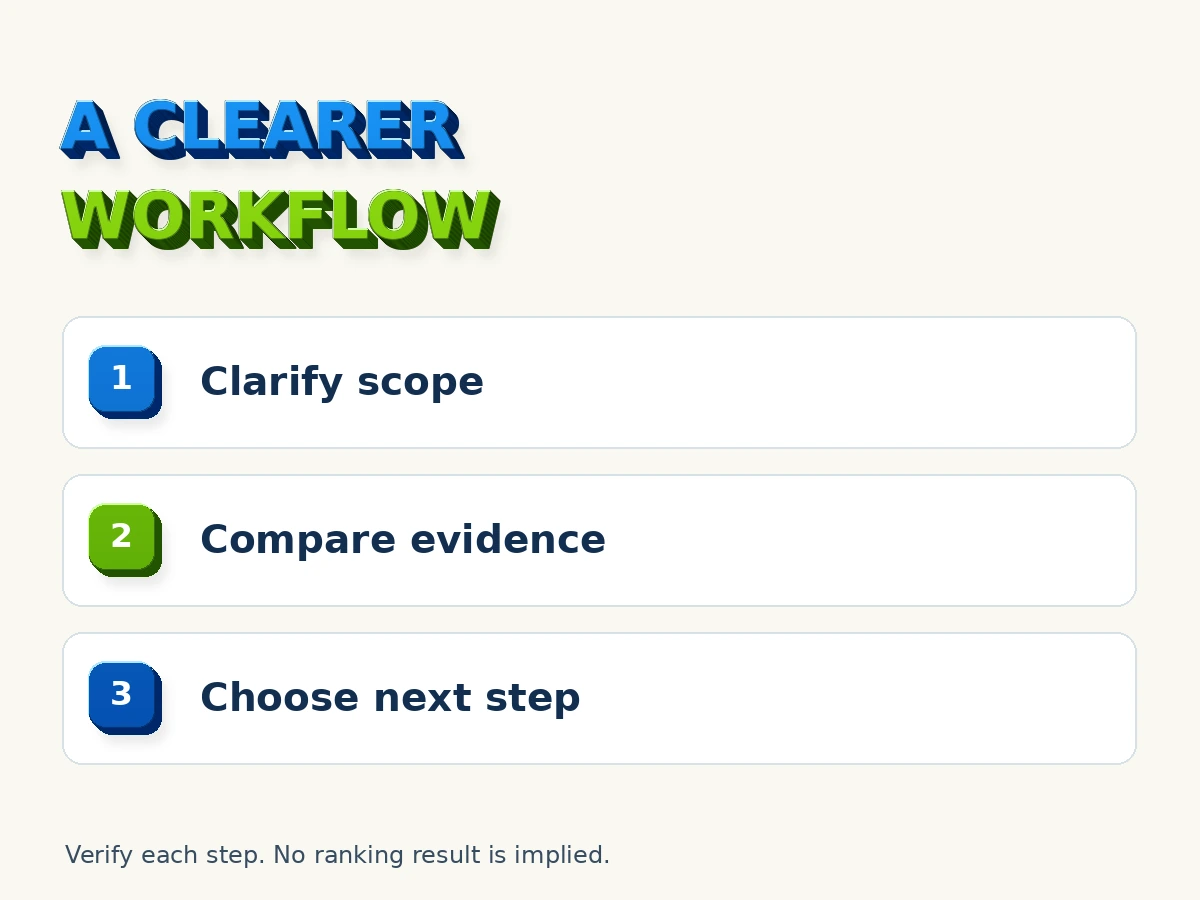
Before accepting an AI SEO proposal, confirm that you understand the first objective, initial deliverables, responsibilities and reporting limits. Resolve material gaps in writing. Keep a copy of the agreed scope alongside the access and cost arrangements.
Then choose a practical first review point based on the work. Technical acceptance may happen when a fix is verified. Search performance requires observation over time. Do not confuse those different timelines or make a ranking promise the condition for accepting a working technical repair.
Our SEO services and AI search optimisation service can be discussed against the same questions. A useful proposal should stand up to scrutiny whichever supplier writes it.
Frequently asked questions
Can an agency guarantee that ChatGPT or Google AI will recommend me?
No agency controls those platforms’ selection systems. Paid placements are a separate purchase; our ChatGPT Ads buying and setup guide explains the checks before spending. Ask for a clear scope, documented work and honest measurement. Treat guaranteed inclusion or fixed rankings with caution.
Should an AI SEO proposal include technical SEO?
It should address technical issues relevant to the objective or clearly state that technical implementation is outside scope. The business needs to know who will handle any identified blockers.
How many articles should the proposal include?
There is no universally correct number. Ask which distinct customer needs each article serves and why an existing page cannot meet that need. Quality and purpose matter more than a fixed output count.
Can I start without case studies?
Yes. Use accurate service information, useful worksheets and clearly labelled examples. Do not manufacture customer outcomes. Build genuine evidence as work is completed and permission becomes available.
What is the simplest way to compare two proposals?
Complete the same deliverable worksheet for both. Compare implementation, acceptance checks, dependencies, reporting and business access as well as the fee. Resolve unclear items before committing.
Request a proposal with a clear scope
Contact Easy Rank with your website, priority service and main concern. We can discuss what needs investigation before recommending a defined scope of work.
About the author

David Gous is the founder of Easy Rank, a Cape Town business working on website design, SEO and AI search visibility. This article offers an original buying worksheet based on primary-source guidance. It makes no claim about client campaign results.