ChatGPT Ads South Africa is now an option for eligible businesses following OpenAI’s 21 October 2026 expansion. The useful question is whether your offer, website and enquiry process are ready for a controlled test. This guide explains setup, local examples, costs and measurement before you spend.
For a Mitchell’s Plain contractor, a Bellville service business or a Cape Town tour operator, the destination matters as much as the message. ChatGPT Ads should connect a relevant customer need to a clear next step. Use the worksheet and tutorial below to decide whether to prepare, verify eligibility or test.
Editorial illustration from the Easy Rank library. It does not depict a ChatGPT Ads client or campaign.
In this guide
Is ChatGPT advertising available in South Africa?
Yes. OpenAI announced South African availability on 21 October 2026. Its expansion includes access through Ads Manager or technology partners. Country availability is a starting point: business category, account review and campaign settings still affect whether an advertiser can deliver ads. Check the current Ads Manager country list before committing resources.
ChatGPT Ads South Africa is therefore a real planning opportunity, rather than a reason to abandon working marketing channels. Start with the customer problem, the offer and your ability to handle enquiries. A new channel deserves a defined test, not an unlimited budget.
This guide combines OpenAI’s launch announcement and current documentation with Easy Rank’s planning recommendations. The local scenarios and financial figures are illustrative. For seasonal product campaigns, our Black Friday product-discovery checklist helps prepare the landing page and buying route before paid traffic. They are not reports of campaigns run by the businesses mentioned.
How ChatGPT Ads works: conversations, context and landing pages
ChatGPT Ads can appear below responses, with an advertiser identity, headline, description, destination and image. OpenAI describes relevance signals that include the conversation, creative, landing page and advertiser context hints. The hints are not exact-match keywords and cannot guarantee placement beside a particular question. See OpenAI’s advertiser introduction.
For ChatGPT Ads, describe the situation where your offer helps. A customer researching planned electrical maintenance needs different information from someone comparing family holiday activities. Clear service boundaries help both the reader and your own enquiry process.
OpenAI’s launch states that ads appear on Free and Go plans and that advertising does not influence its answers. Do not confuse the overall ChatGPT audience with the audience eligible to see ads. A sponsored placement is also not an endorsement of your business.
For organic discovery, see our separate guide to ChatGPT visibility in South Africa. Buying ChatGPT Ads does not buy an organic recommendation.
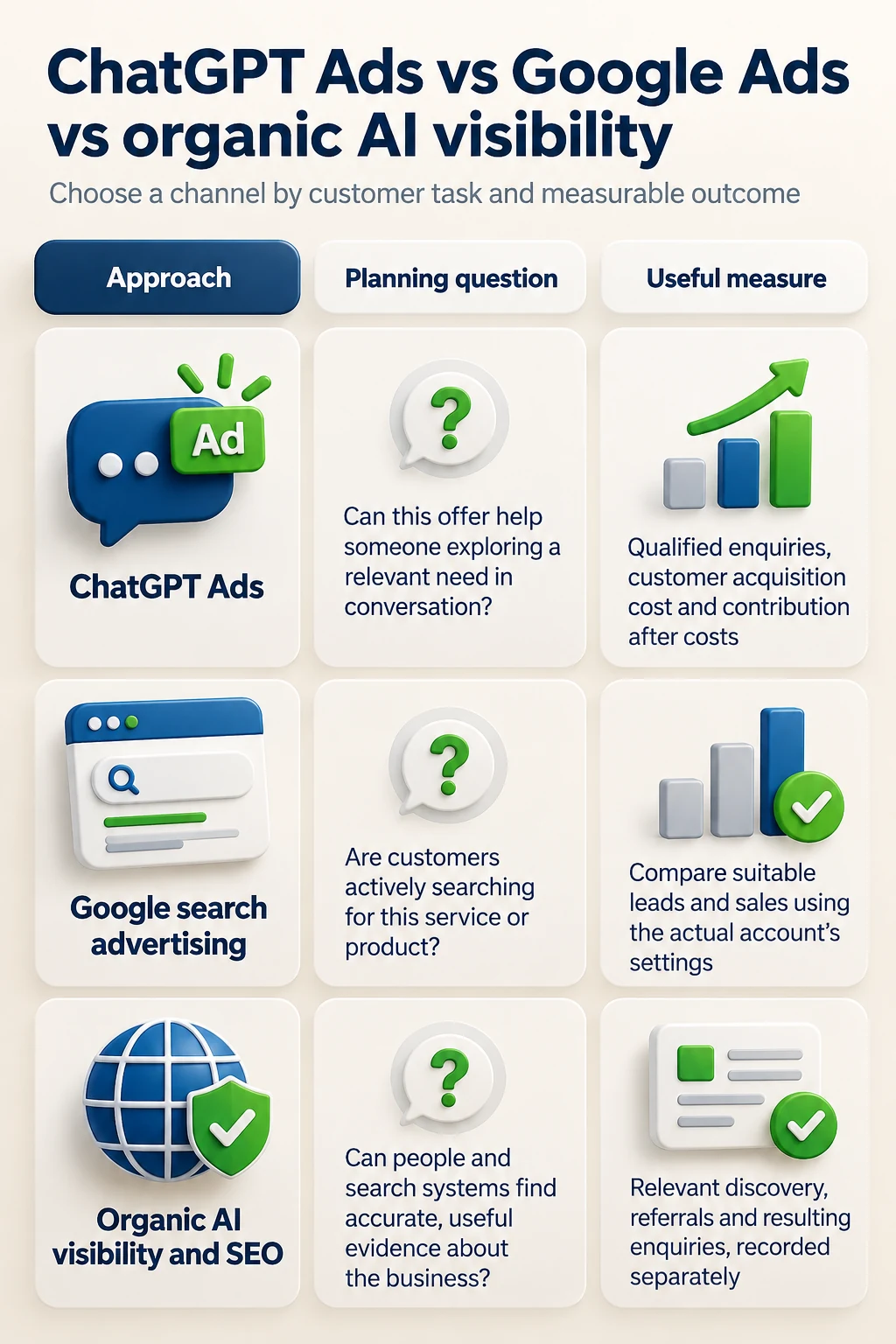
ChatGPT Ads vs Google Ads vs organic AI visibility
Compare channels by customer task and measurable outcome. Read the accessible summary below or select the graphic to view the full-size WebP.
ChatGPT Ads: ask whether the offer helps someone exploring a relevant need in conversation. Measure qualified enquiries, customer acquisition cost and contribution after costs.
Google search advertising: ask whether customers are actively searching for the service or product. Compare suitable leads and sales using the actual account’s settings.
Organic AI visibility and SEO: ask whether people and search systems can find accurate, useful evidence about the business. Record relevant discovery, referrals and resulting enquiries separately.
This is a decision framework, not a performance ranking. Compare actual results for comparable offers. ChatGPT Ads may deserve a test while another channel remains your main source of customers. Avoid moving the whole budget because a launch is receiving attention.
Our AI search conversions guide explains why being mentioned, receiving a visit and winning a customer are different events. Apply that distinction to paid placements too.
The Easy Rank readiness check: prepare, verify or test
Before using ChatGPT Ads, write down one offer, one destination and one business outcome. Then apply the checklist below. It is a planning worksheet, not an official OpenAI eligibility score.
Offer: record what the customer can buy, book or request. Clarify the service if this is missing.
Capacity: name the person who handles enquiries and delivers the work. Assign an owner before proceeding.
Geography: verify the real service area and the supported campaign locations.
Destination: use a relevant mobile page with working contact actions. Repair any failed step in the journey.
Economics: record gross profit and affordable acquisition cost. Build the calculation if either is unknown.
Measurement: submit a test enquiry and confirm it reaches staff and is recorded correctly. Fix tracking before launch.
Prepare first when the offer, page or enquiry process fails. Verify eligibility when account access, category rules or geography is uncertain. Consider a test when those foundations work and you can afford a disappointing result.
For ChatGPT Ads, enthusiasm cannot replace fulfilment. A sole trader already booked for the next month may benefit more from a waiting-list process than additional immediate enquiries. Our website handover checklist also helps establish who controls the website and reporting access.
Practical ChatGPT Ads examples for Mitchell’s Plain and Cape Town
Local context: service areas must match what the business can fulfil and the campaign can support.
Cape Town minibus taxis beneath Mitchells Plain and Hanover Park signs. Photo supplied for this guide; the image does not identify a ChatGPT advertiser.
The following are hypothetical planning examples. Naming a business does not mean it advertises on ChatGPT, has approved these drafts or has achieved any stated outcome.
An Eastridge electrical business: qualify the job before the call
Consider an Eastridge business such as WWJDElectrical Services when thinking about local trades. Before developing ChatGPT Ads, confirm its current services, coverage, availability and approved claims directly. A sample customer situation is a homeowner planning electrical work and comparing what to ask a contractor.
A suitable landing page would explain the relevant service, information needed for a quote and actual areas served. An enquiry could ask for the suburb, a short description and preferred contact method. Avoid asking the visitor to upload unnecessary personal documents.
Imagine a Bellville upholstery business offering dining-chair re-covering. ChatGPT Ads could lead to a page explaining the quote process, fabric choices, collection arrangements and expected next step. The example does not assume any particular business offers collection.
Compare two messages: refreshing worn dining chairs and coordinating chairs with a room update. Keep each message accurate. Both can lead to a relevant page, but record which version produces useful enquiries. A generic homepage listing every service makes that comparison harder.
A Cape Town tour operator: turn research into a workable itinerary
A hypothetical family is comparing December outings, travel time and activities for different ages. A tour operator considering ChatGPT Ads should explain route options, inclusions, accessibility information, booking conditions and how availability is confirmed.
Send the visitor to the relevant experience page. Ask for travel date, party size and essential requirements. Do not advertise availability that staff cannot confirm. The practical planning questions in our Cape Town December guide can inform useful customer research.
A local retailer: protect the margin after delivery
For a hypothetical Cape Town retailer, ChatGPT Ads must lead to accurate product information, stock and delivery terms. A low-value order may become unprofitable after fulfilment and advertising. Compare contribution per order before deciding that more orders would help.
These examples also suit a broader inclusion lens: women-owned, Khoi and San-owned and Cape Flats businesses need clear offers and workable economics, rather than assumptions about their customers or access to budget.
How to advertise on ChatGPT: a practical setup tutorial
This tutorial follows public OpenAI documentation checked on 26 October 2026. It is not a recording of a live South African account walkthrough. Labels and available features may differ. Do not submit a campaign while still working out its budget or start date.
Step 1: define the first test on paper
For ChatGPT Ads, choose one offer and one customer need. Record the destination URL, enquiry definition, spend approval and review decision. For example: test enquiries for one planned service, then decide whether lead quality justifies continuing.
Name the campaign clearly, such as “Cape Town | Service quote | Initial test”. Do not mix unrelated products merely because the same business sells them. Keep a dated copy of the approved brief.
Step 2: create or join the correct advertiser account
Open the official OpenAI Ads Manager. If an account already exists, request an invitation instead of creating duplicates. Check the business details and account country, currency and time zone carefully. OpenAI says those three selections cannot be changed after creation.
Its account setup instructions describe an option to skip initial ad creation and enter Ads Manager. Use that route if you are still preparing. Review public brand and registered legal names separately.
Step 3: confirm account readiness and billing
Complete the requested verification and billing through the official interface. Give collaborators the appropriate role, rather than sharing a password. Keep ownership and billing responsibility clear.
With ChatGPT Ads, onboarding can create a campaign that becomes eligible to deliver after approval and other requirements are met. If you are not ready, confirm the campaign is paused. Account creation is not a harmless substitute for reviewing delivery settings.
Step 4: choose the objective and budget
Choose Views for impression-based awareness, Clicks for visits to your website or an eligible Conversions objective for a supported customer action. Record the chosen billing method: conversion optimisation can still charge for valid clicks or impressions, rather than completed sales. OpenAI’s campaign guide explains the available objectives; conversion optimisation does not mean you pay only for completed sales.
Review total exposure, start conditions and billing before submitting ChatGPT Ads. Write your approval in the campaign record. If a needed scheduling control is unavailable during onboarding, stop before publication rather than launch first and fix dates afterwards.
Step 5: check geography and customer fit
Inspect the supported locations in the account. A page describing Mitchell’s Plain does not itself restrict campaign delivery there. OpenAI’s targeting documentation distinguishes eligibility settings from descriptive context.
For ChatGPT Ads targeting Cape Town customers, check the actual available location controls and the offer’s service area together. If they do not fit, postpone the test. Do not spend in an unsuitable country simply to progress through onboarding.
Step 6: write useful context hints
Context hints explain the product, customer need and situation at ad-group level. For a hypothetical planned-maintenance offer, describe the work supported, actual service area and information needed for a quote.
Avoid a string of suburb names or commands telling ChatGPT to recommend you. ChatGPT Ads context hints are relevance guidance, not a placement reservation. Keep the statements consistent with the destination page.
Step 7: create distinct messages and a relevant destination
Draft variations that answer different needs. For example, one message might explain a quote process while another highlights a clearly defined service. Review any suggested text against what the business can deliver.
OpenAI’s creative guidance recommends relevant destinations and accurate, useful messages. For ChatGPT Ads, use the specific service or product page rather than automatically using the homepage. Confirm mobile readability, image relevance and accessible link labels.
Worked creative example: a planned service quote
For a hypothetical local contractor, a ChatGPT Ads draft might use the headline “Plan your electrical work with a clear quote”. Supporting copy could explain that customers can describe the job and service location to request the next available assessment. Publish it only if the contractor actually provides that process.
A corresponding context hint could describe homeowners comparing contractors for planned work, within the business’s verified service area. The destination should explain the assessment process and which work is included. Do not insert emergency availability, qualifications or a free inspection unless those claims are verified.
A second ChatGPT Ads variation could focus on understanding the scope before booking. Change the angle, not the underlying promise. Record why each message exists so the review can connect enquiry quality to customer need.
Step 8: test measurement, then review delivery
Before activating ChatGPT Ads, complete a labelled test enquiry. Confirm receipt, confirmation messaging and the correct reporting event. Review the destination with its tracking parameters. Obtain the owner’s approval of spend and settings.
After launch, check delivery and lead handling against the brief. Keep a change log. If enquiries are unsuitable, investigate the offer, geography and page before raising spend. This guide does not launch a campaign or authorise expenditure.
ChatGPT advertising costs in South Africa: minimum budget vs actual cost
At the 26 October 2026 check, OpenAI’s campaign table lists an R83 minimum daily budget for ZAR-billed accounts. That is a platform minimum, not a recommended test budget or a South African cost-per-click benchmark. Verify the amount and billing currency in your account before approving spend. The figure comes from the minimum campaign budget table.
A daily budget is an average delivery target. OpenAI’s daily-budget guidance describes daily fluctuations and weekly controls. Use the account’s current rules to calculate exposure, particularly after budget changes. For a firm overall limit, examine the available campaign-total controls.
Separate ChatGPT Ads media spend from landing-page work, tracking, creative and management fees. No reliable South African CPC or lead-cost benchmark is established by this article. Avoid converting an overseas suggested bid into a local performance forecast.
Ask a supplier to state exactly what is included, who owns the account and how additional work is approved. Our proposal buying questions help you evaluate scope before committing.
Work out what you can afford per qualified enquiry
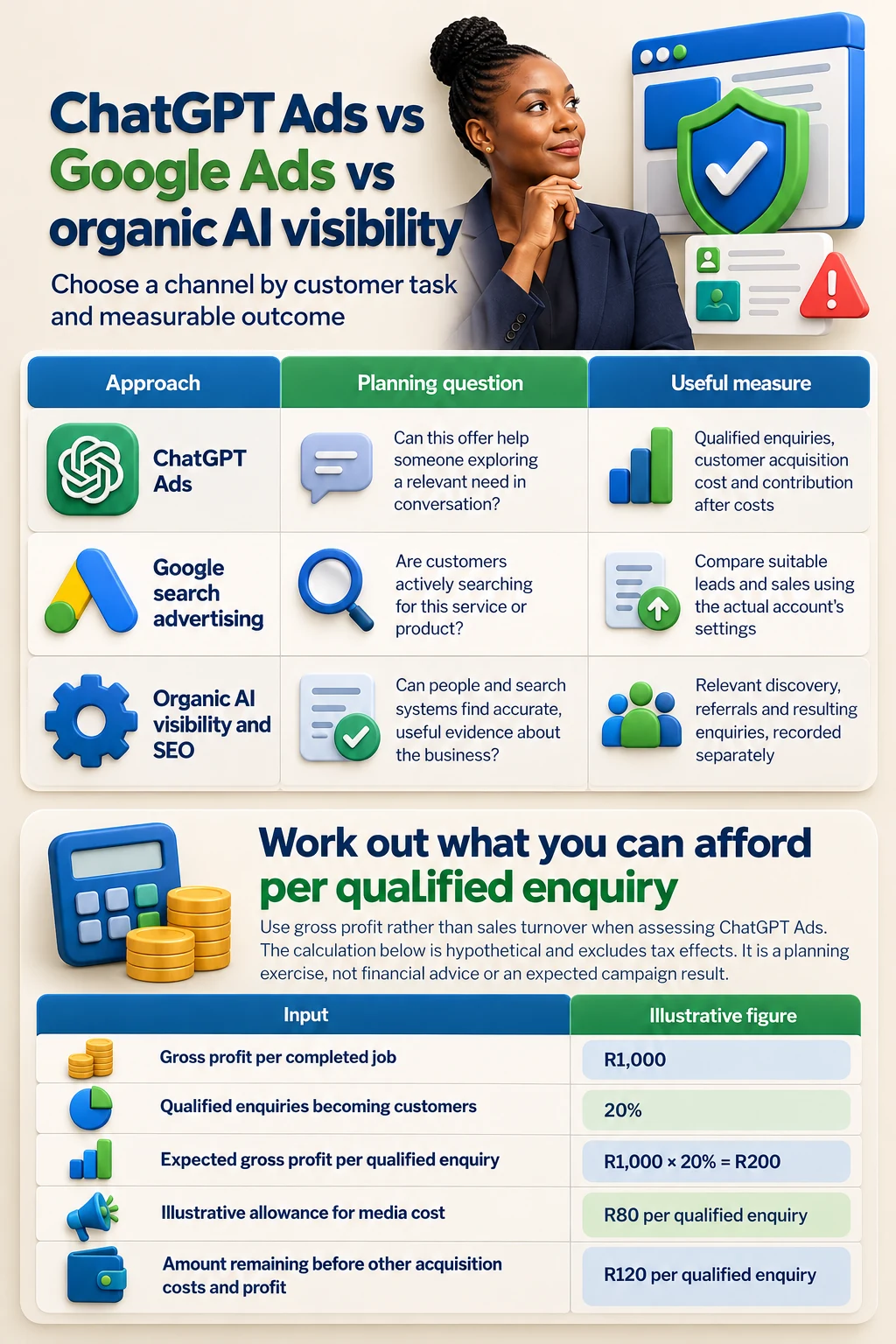
Use gross profit rather than sales turnover when assessing ChatGPT Ads. The calculation below is hypothetical and excludes tax effects. It is a planning exercise, not financial advice or an expected campaign result.
Hypothetical enquiry economics, not a market benchmark or expected campaign result. The calculation is repeated below in readable text. Select the graphic to view the full-size WebP.
Illustrative allowance for media cost: R80 per qualified enquiry.
Amount remaining before other acquisition costs and profit: R120 per qualified enquiry.
R200 is not the amount this business should automatically bid for a lead. Staff time, management fees, unsuccessful quotes and other acquisition costs still matter. If the close rate falls to 10%, expected gross profit per qualified enquiry falls to R100.
For your ChatGPT Ads worksheet, replace every number with your own evidence. Record the offer, gross profit, close rate, target enquiry cost, total test allowance and review date. If these inputs are unknown, mark them as assumptions and use conservative limits.
Define “qualified” before the test: appropriate service, workable location, genuine requirement and a reachable prospect. A customer who needs something you do not sell is not a useful lead merely because the form was completed.
Measure ChatGPT Ads enquiries, sales and paid traffic separately
OpenAI’s conversion measurement documentation explains the platform’s measurement options. A practical business record should also connect the enquiry to its outcome. A form event alone cannot tell you whether the customer was suitable or bought.
For ChatGPT Ads, record campaign, enquiry date, service requested, qualification outcome and eventual sale. Keep personal information in the appropriate business system, not in URL parameters. Use consistent campaign tags that distinguish paid traffic from organic ChatGPT referrals.
Follow our AI referral measurement guide when defining reporting categories. If the same visitor appears in several reports, do not count those reports as separate customers. Check event duplication and attribution settings before announcing a result.
ChatGPT Ads reporting can lag. OpenAI also notes that review crawlers may visit tagged destinations without generating billable clicks. Investigate differences between platform clicks and analytics visits; do not assume either report directly proves fraud or missing customers.
Judge a small test as a small test. Low volume may be insufficient to choose a winning message. Report spend, period, observations and uncertainty together, including tests that did not produce suitable enquiries.
Before adding an advertising pixel or server-side events, review the information shared, your privacy notice and required consent with the responsible person. OpenAI’s measurement guidance requires appropriate disclosures and permissions. Hashing contact data does not remove the need to assess whether sharing it is permitted.
Eligibility, ad policies and common mistakes
Check OpenAI’s current advertising policies before preparing ChatGPT Ads. Reviews cover the advertiser, creative and destination. Sensitive and regulated categories have restrictions; a general country launch does not establish approval for a medical, financial or legal advertiser.
Keep business claims, availability and service areas accurate. Do not imply OpenAI endorses the business or copy its interface to make an ad look like an answer. Changing a rejected destination to conceal disallowed content is not a sound route to approval.
Operational mistakes matter too: directing every offer to the homepage, counting contact-button taps as customers, leaving staff unaware of the test and increasing spend before checking lead quality. ChatGPT Ads cannot compensate for an unanswered enquiry inbox.
Protect working organic content. Our ChatGPT SEO service addresses a separate visibility task; paid testing should not require dismantling existing search foundations.
A practical first-test plan for a South African small business
Use ChatGPT Ads as a controlled learning exercise. First, complete the readiness worksheet and fix failed contact actions. Next, verify account eligibility and select an offer with enough capacity and margin to justify investigation.
Prepare a small set of distinct messages, a relevant destination and a written measurement plan. Agree the total exposure and conditions for pausing. The first review should ask whether delivery is occurring, tracking is reliable and staff can handle enquiries.
At the commercial review, compare qualified enquiry cost and customer outcomes against your assumptions. Continue, revise or stop based on evidence. Do not automatically renew ChatGPT Ads because impressions increased.
Start through the official Ads Manager, confirm account and category eligibility, prepare a relevant landing page and create the campaign using available controls. Review billing, tracking and delivery status before submission. The tutorial above explains the preparation sequence for ChatGPT Ads.
How much do ChatGPT Ads cost in South Africa?
The checked campaign documentation lists an R83 minimum daily budget for ZAR billing. Your actual cost depends on billing model, delivery and results. The minimum is neither a recommended test budget nor a guaranteed cost per enquiry. Verify current account terms.
Can I target Cape Town or Mitchell’s Plain?
Check supported locations in your account and campaign type. Availability can vary. Naming a suburb in an ad, page or context hint does not restrict delivery to that suburb. Do not promise suburb targeting without verifying the relevant controls.
Do ChatGPT Ads improve organic ChatGPT rankings?
No paid route to organic recommendations is established here. OpenAI states that advertising does not influence its answers. Measure paid placements and organic visibility separately, with different actions and reporting.
Are ChatGPT Ads better than Google Ads?
There is no universal winner. Compare suitable customer acquisition costs for your offer and market. Preserve a working channel while testing another. A new platform or a lower click cost does not, by itself, prove better commercial performance.
Why are my ChatGPT Ads not delivering?
Check verification, billing, review status, active settings, budget and eligible locations. An approved creative alone does not establish delivery. Use the platform’s current troubleshooting guidance before changing several settings at once.
Does the advertiser see private ChatGPT conversations?
OpenAI says it keeps conversations private from advertisers. Do not build your enquiry process around obtaining a person’s chat history. Ask only for information needed to assess the requested service.
What should a small business fix before using ChatGPT Ads?
Clarify the offer, repair mobile contact actions, confirm fulfilment capacity and test measurement. Complete the worksheet above. If you cannot identify a suitable enquiry or calculate an affordable acquisition cost, preparation is the more useful first step.
Is your website ready for ChatGPT advertising?
Send Easy Rank your website, priority offer and service area. We can scope a readiness review covering the landing page, contact journey and measurement. Read about ChatGPT Ads support in South Africa or request a tailored proposal. Campaign launch and media spend require separate approval.
David Gous is the founder of Easy Rank in Cape Town, working on websites, SEO and AI search visibility. This guide combines current OpenAI documentation with an original readiness worksheet and hypothetical planning examples. It does not claim completed ChatGPT advertising campaigns or guaranteed results.
Sources and editorial method
Platform claims were checked against the linked OpenAI announcements, Help Centre and developer documentation on 26 October 2026. Interface steps follow public documentation rather than a live account test. Financial examples are fictional. Review availability, policies and account controls again before acting.
To provide the best experiences, we use technologies like cookies to store and/or access device information. Consenting to these technologies will allow us to process data such as browsing behavior or unique IDs on this site. Not consenting or withdrawing consent, may adversely affect certain features and functions.
Functional
Always active
The technical storage or access is strictly necessary for the legitimate purpose of enabling the use of a specific service explicitly requested by the subscriber or user, or for the sole purpose of carrying out the transmission of a communication over an electronic communications network.
Preferences
The technical storage or access is necessary for the legitimate purpose of storing preferences that are not requested by the subscriber or user.
Statistics
The technical storage or access that is used exclusively for statistical purposes.The technical storage or access that is used exclusively for anonymous statistical purposes. Without a subpoena, voluntary compliance on the part of your Internet Service Provider, or additional records from a third party, information stored or retrieved for this purpose alone cannot usually be used to identify you.
Marketing
The technical storage or access is required to create user profiles to send advertising, or to track the user on a website or across several websites for similar marketing purposes.
 Skip to content