 Skip to content

Once-Off SEO vs Monthly SEO: 7 Essential Buying Checks
By David Gous · · 11 min read
Categories: SEO · Business Growth
Tags: Once-Off SEO · Monthly SEO
Once-off SEO vs monthly SEO is a decision about the work your business needs, who will implement it and how the next decision will be made. A defined repair or setup can suit a project. The Black Friday SEO preparation guide gives a seasonal example of defining product-page, data and checkout work before choosing an engagement. Recurring content development, review and improvement may suit ongoing work. Neither billing format guarantees search rankings or enquiries.

This guide gives South African business owners seven buying checks and a scope worksheet. It helps separate diagnosis, implementation, maintenance and continuing search work. You can use it before you have case studies, a large marketing budget or a reliable history of website reporting.
Documentation checked: 18 October 2026. The scenarios are fictional and contain no assumed prices, traffic increases or client results. The decision framework is an editorial tool.
In this guide
Understand the work before the billing model

A once-off project has a defined scope and completion point. Examples may include investigating an indexing issue, repairing a specified problem or improving an agreed set of pages. The proposal should explain what is included and how completion will be checked.
Monthly SEO usually describes an ongoing relationship. Its value depends on a useful backlog, implementation and review. A recurring invoice does not establish that the right work is happening. The business should understand how priorities are selected and what evidence informs the next month.
Maintenance is another category. Backups, updates and operational care help keep the website working. They can support an SEO programme but should not automatically be described as a complete search strategy. A supplier may provide several categories together if the scope makes them clear.
Our SEO services and website maintenance service address different needs. Before comparing options, write down the problem you are trying to solve in language the business can recognise.
Seven checks for once-off SEO vs monthly SEO decisions
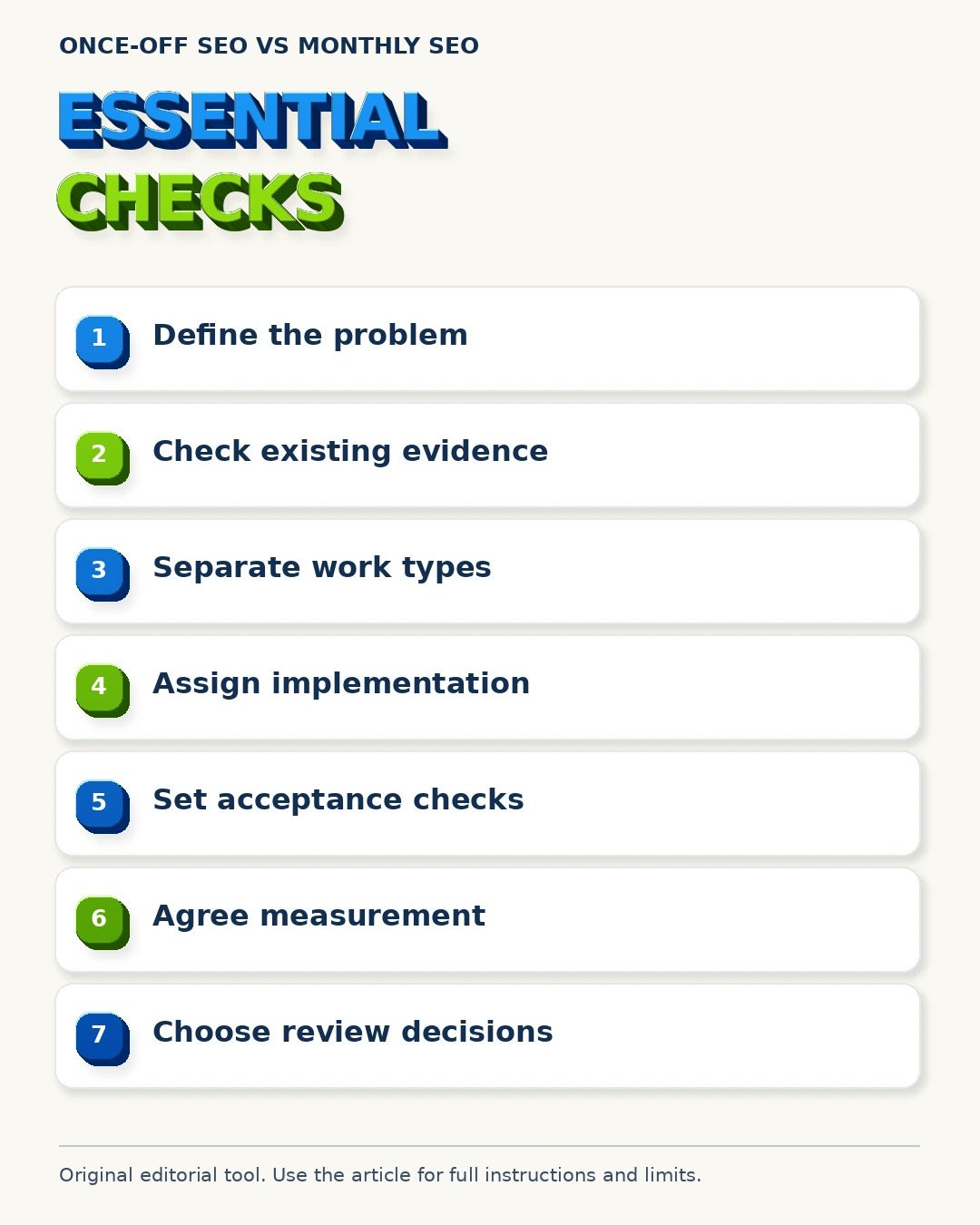
Use these checks to build a sensible first scope. They are particularly useful when a quote arrives before anyone has established the website’s condition. A clear diagnosis can prevent both an oversized ongoing plan and an under-scoped project.
1. Can you describe the actual problem?
“We need SEO” is a starting concern, not yet a defined project. Try to describe what happens now and what the business needs to understand or improve. For example, customers may struggle to find service information, a redesigned page may be missing or suitable enquiries may not be recorded.
If the cause is unknown, consider a defined investigation before committing to a long list of repairs or articles. Where a proposal includes paid AI traffic, our ChatGPT Ads guide helps separate campaign preparation from continuing management. The investigation should produce evidence and prioritised recommendations. Make clear whether implementation is included or a separate decision.
Google’s guide to hiring an SEO provides useful questions for supplier discussions. A good recommendation should make sense in the context of your website rather than depend on a generic package description.
2. What evidence is available now?
Identify the website pages, reporting access and operational information you have. Search Console, analytics and enquiry records answer different questions. A public-site review cannot reveal the quality of private leads or establish sales performance.
If reporting is incomplete, record that limitation. You can still repair an obvious broken route, but you should not invent a baseline conversion rate. A scope may need measurement setup before later performance comparisons become useful.
Our AI SEO measurement guide and AI visibility measurement guide explain related distinctions. Ask the supplier what the existing evidence can support before accepting outcome forecasts.
3. Which work is finite, and which will recur?
Separate a known repair from a continuing business need. Fixing an identified broken redirect can have a clear acceptance test. Keeping changing services, products and content useful requires continuing decisions, even if the same supplier does not do all the work.
Some projects contain both. A website may need an initial technical cleanup followed by periodic content and measurement reviews. A proposal can phase the work so that later scope follows what the initial investigation establishes.
The once-off SEO vs monthly SEO question becomes more concrete when each activity has a reason and an owner. Do not assume that everything technical is once-off or that every content task requires a permanent retainer. Define the actual requirement.
4. Who will implement the recommendations?
Ask whether the supplier provides advice, makes the changes or coordinates with your developer. An audit can be useful, but an unimplemented document does not repair a website. The business needs capacity and responsibility for the next step.
For each proposed action, identify the person with suitable access and the business contact who confirms facts. A service-page rewrite needs factual review. A configuration change needs a technical check. A form repair needs delivery verification.
Our AI SEO for WordPress service is relevant to implementation on that platform. The proposal should still name the systems and deliverables involved rather than assume that “WordPress SEO” explains the work.
5. How will completed work be accepted?
Agree on checks that match the deliverable. A page can be checked against an approved brief and accurate facts. A broken-link repair can be verified at the original address and final destination. A reporting event can be tested against its definition.
Search ranking is not an appropriate immediate acceptance test for every repair. Platforms need time to process changes and many factors affect what they show. Separate verification that work was completed correctly from later observation of search and business performance.
Google’s recrawl documentation explains request routes and their limitations. Do not pay for an “instant ranking” condition that the supplier cannot control. Ask for evidence of the actual implementation instead.
6. What will measurement mean?
Define the difference between visibility, visits, interactions and suitable enquiries. If a monthly report counts all contact-button clicks as leads, it can overstate what the business actually received. Agree on definitions the team can maintain.
For AI-search observations, record the platform, query, date and cited URL. A few screenshots may help identify a visibility question, but they are not a complete market share measure. Treat estimates and observed samples as such.
Our AI search conversions guide connects these discussions to customer actions. The report should be useful for deciding what to do next, rather than merely showing a number that rises.
7. What happens at the first review?
Agree on the decision, not only the meeting. You might approve the next priority, verify project completion, adjust an ongoing plan or pause an activity that lacks a useful purpose. The evidence should inform that choice.
For a project, record what remains outside scope and who will handle it. For monthly work, explain how the backlog changes as issues are resolved and the business evolves. Repeating the same activity count indefinitely is not a strategy by itself.
A once-off SEO vs monthly SEO review should also consider the business’s own capacity. If staff can maintain accurate service information but cannot implement technical repairs, the appropriate supplier scope may be different from that of a business needing full content support.
Compare project, ongoing and maintenance work
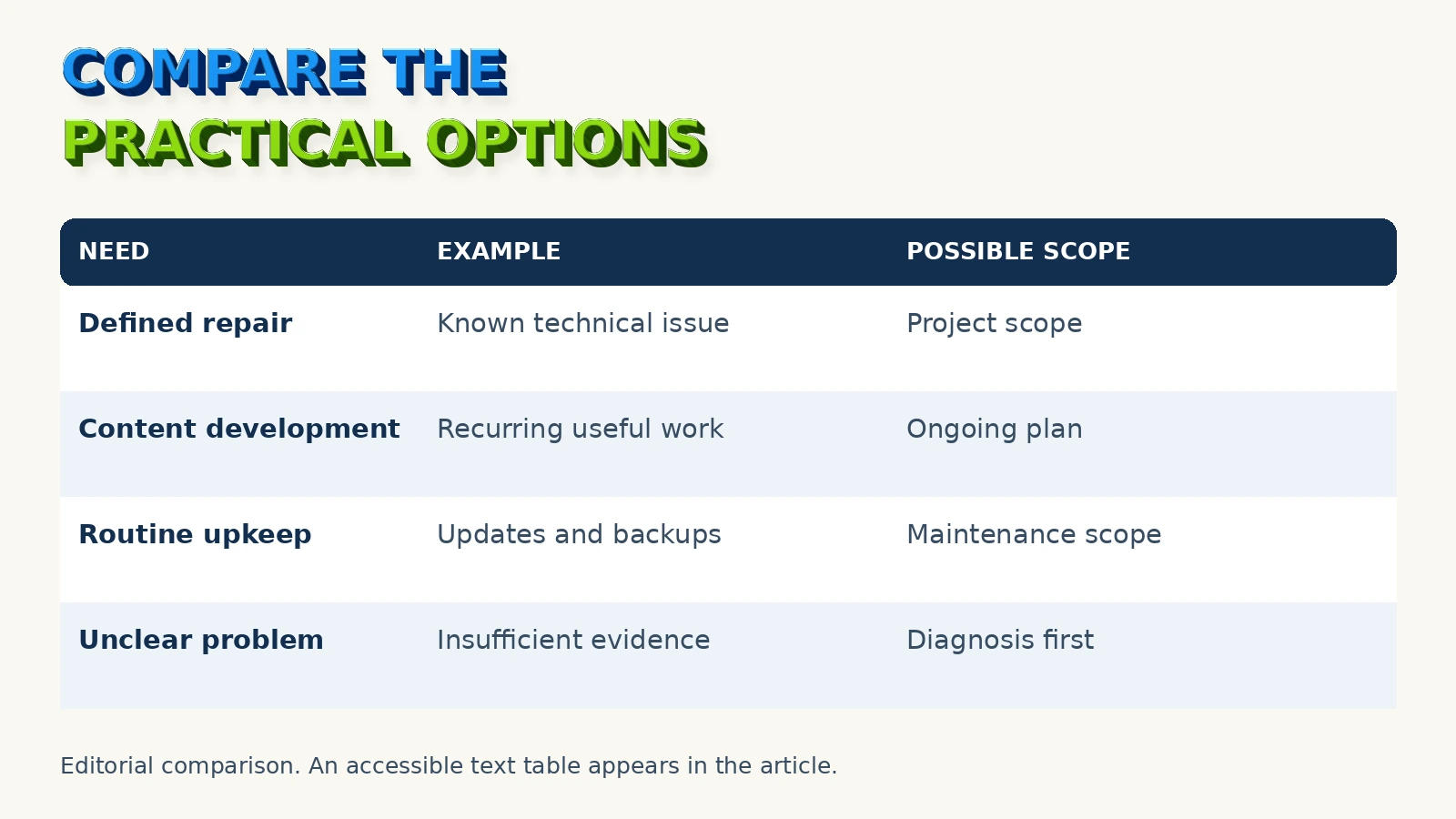
This table shows possible scope patterns. It is not a price list or a universal recommendation. The same activity can sit within different arrangements when responsibilities and acceptance checks are clearly agreed.
| Need | Possible scope | Useful acceptance or review evidence |
|---|---|---|
| Unknown cause of a visibility problem | Defined diagnostic project | Evidence, limitations and prioritised next actions |
| A known technical fault | Scoped repair project | Relevant functional or technical test |
| A planned set of service-page improvements | Defined content project | Approved facts, complete pages and working next steps |
| Continuing useful content and improvements | Ongoing SEO plan | Completed work, observed evidence and revised priorities |
| Updates, backups and operational care | Maintenance arrangement | Agreed checks, responsibility and recovery process |
| Changing offers or coverage | Recurring information review | Accurate affected pages and public details |
Our AI SEO pricing information and local SEO pricing guide provide related context. Request a scope based on your requirements instead of assuming that another business’s arrangement applies to you.
There is also a difference between a small scope and a low-quality scope. A focused project can be useful when it solves a defined problem. An inexpensive package can still be poor value if its deliverables have no connection to the website’s needs. Our cheap SEO services guide explores that buying concern.
Build a work-scope worksheet
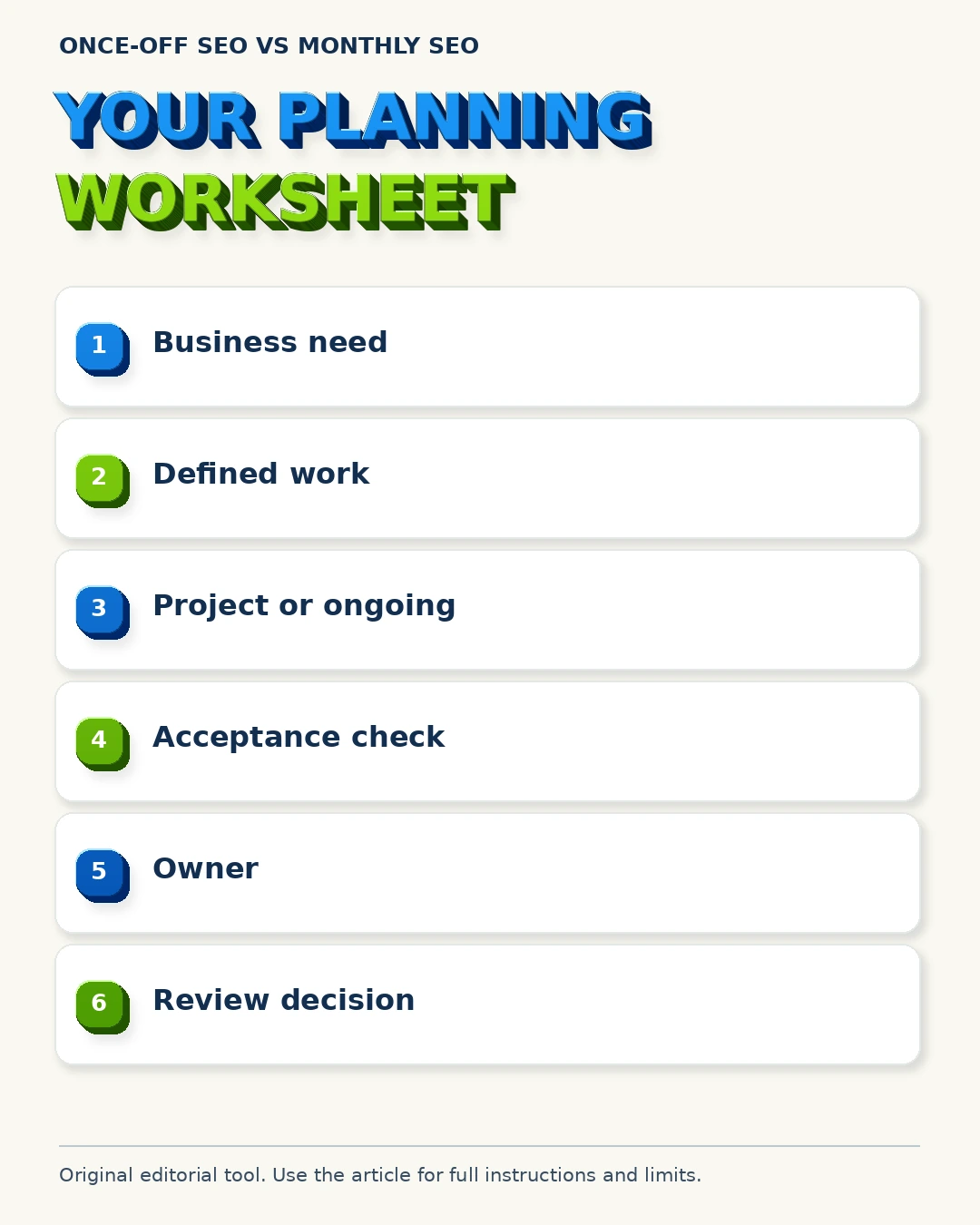
Create one row per proposed activity. Complete it with the supplier before deciding the billing format. This makes dependencies visible and helps the business understand which responsibilities remain with its own team.
| Worksheet field | What to record |
|---|---|
| Business need | The problem or opportunity in plain language |
| Evidence | The page, report or operational observation |
| Defined work | What will actually be done |
| Work type | Diagnosis, implementation, maintenance or continuing improvement |
| Deliverable | What the business receives |
| Acceptance check | How completion or correct operation is verified |
| Responsible person | Who implements and who approves facts |
| Dependency | Access, content or another supplier’s work |
| Review evidence | What will be considered later |
| Next decision | Complete, continue, change, investigate or stop |
If an activity cannot be described clearly, ask for clarification before accepting it. “AI optimisation” or “authority building” may describe a broad category, but neither is a sufficiently specific deliverable on its own.
For structured data, the worksheet should name the actual content being described and the validation approach. Google’s structured-data policies remain relevant. Our schema SEO service concerns accurate implementation rather than guaranteed rich results.
Use hypothetical buying scenarios
These examples illustrate how to choose a scope. They contain no assumed customer results, fees or performance improvements. Your own decision should follow the evidence from your website and business.
Scenario one: a known enquiry problem
A business can reproduce a form-delivery failure. A scoped investigation and repair may be an appropriate starting point. Acceptance would include a clearly labelled test arriving at the intended destination, with suitable confirmation for the visitor.
That repair does not establish that the website has enough relevant traffic or that all future enquiries will be suitable. Those are separate questions. A monthly SEO plan may or may not be justified after the immediate problem is resolved.
Scenario two: a website with unclear service pages
A business has accurate services but vague page copy and no clear enquiry instructions. A defined service-page project could establish useful foundations. The owner confirms scope, coverage and the process before publication.
If the business then needs continuing buying guides and regular content review, an ongoing arrangement may follow. The transition should be deliberate. It should not be assumed merely because the initial writing project has ended.
Scenario three: the business has no reliable baseline
A business believes it has lost visibility but lacks reporting access and a record of recent changes. Begin with diagnosis and access clarification. Do not assume a particular Google update or recommend a large content programme before examining the evidence.
Google’s SEO Starter Guide provides foundational context. Our AI SEO for small businesses service can be discussed where prioritisation is the main challenge.
Scenario four: the website changes regularly
A business updates services, coverage or products often. It may need recurring information review alongside technical maintenance. The ongoing plan should identify who supplies accurate facts and how changes reach the relevant pages.
A retainer is useful only if the work remains purposeful and the team can deliver it. A business with strong internal capability might keep some responsibilities in-house and commission specific specialist work when needed.
Set a useful once-off SEO vs monthly SEO review decision
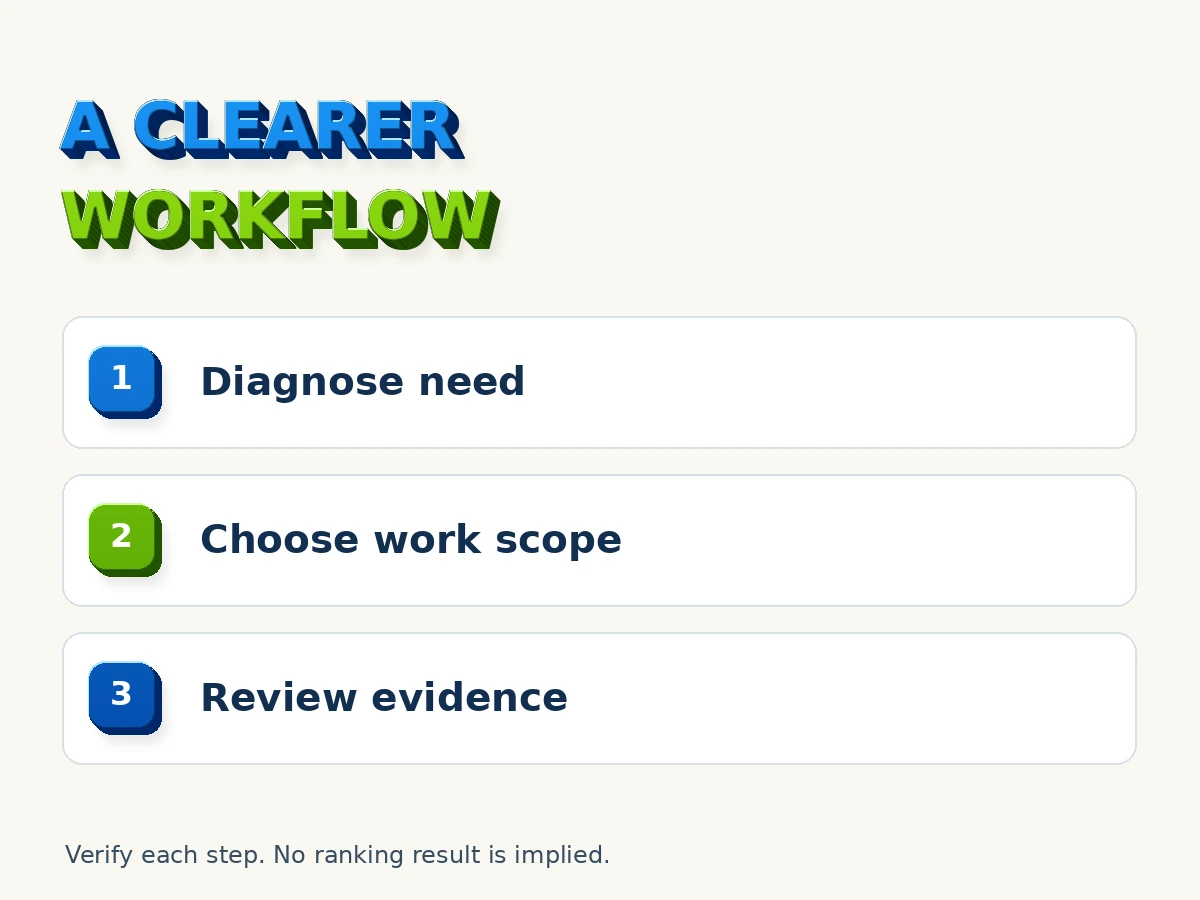
At the first review, separate completed work from unresolved questions. Confirm whether acceptance checks passed. Then examine available search and business evidence with its limitations. Avoid claiming causation from a short period or a small sample.
For completed projects, record any remaining tasks and the ongoing care needed. The website will still require accurate information and operational maintenance, even if the SEO project has a clear end. That does not automatically require the same supplier or billing arrangement.
For monthly work, review the backlog and business priorities. A useful plan can change as evidence improves. If the work has become repetitive and its purpose cannot be explained, ask for a revised scope before continuing automatically.
Google’s AI-search guidance is helpful when evaluating new platform-related recommendations. A changing interface does not make every speculative service essential. The proposal should explain the practical need and the evidence behind it.
What to ask before accepting a quote
Ask what is included, who implements it, what access is needed and how completion will be checked. Clarify content review, software costs, reporting and the process for additional work. Keep the agreed answers with the proposal.
If case studies are unavailable, ask for a transparent explanation of the proposed method and deliverables. Do not request or accept invented proof. A supplier can demonstrate understanding through a reviewable plan while being honest about its evidence.
Our AI search optimisation service can be evaluated against these same questions. A once-off SEO vs monthly SEO decision should leave you understanding the work you are buying and the decision that follows it.
Frequently asked questions
Can once-off SEO work be worthwhile?
Yes, where the scope addresses a defined need and includes appropriate implementation and verification. It does not mean the website will never need further work or maintenance.
Is monthly SEO always necessary?
No universal rule applies. Ongoing work can be useful when there are continuing, justified priorities. The proposal should explain those priorities and how they will be reviewed.
Does maintenance include SEO?
Only to the extent stated in the agreed scope. Updates and backups are operational work. Search strategy, content development and measurement may be separate responsibilities.
Which option ranks a website faster?
The invoice frequency does not determine ranking speed. The actual problems, implemented work, competition and search processing matter. No supplier can guarantee a specific ranking timeline.
What should I buy first if I do not know the problem?
Consider a defined diagnostic scope with clear evidence, limitations and prioritised next actions. Confirm whether implementation is included. Use the findings to decide the next work rather than committing to an unexplained package.
Choose the work your business needs
Contact Easy Rank with your website, priority service and the problem you want to understand. We can discuss whether the appropriate first step is investigation, a scoped project or continuing support.
About the author

David Gous is the founder of Easy Rank in Cape Town, working on website design, SEO and AI search visibility. This guide provides an original buying worksheet and fictional planning scenarios. It does not claim customer performance results or guaranteed rankings.