 Skip to content
By David Gous | Published: 15 October 2026 | Sources checked: 15 October 2026
AI search conversions happen when discovery through an AI search experience contributes to a useful business action, such as a qualified enquiry, booking or sale. A citation only shows that a source was referenced. To earn the next step, your website must explain who you help, support its claims and make the buying process clear.
Our marketing service for law firms applies this distinction to practice-area information, consultation requests and the firm’s own definition of a suitable enquiry.
Your business appears in an AI answer. You take a screenshot. It feels like progress.
Then you check the inbox. No relevant enquiries. The phone is quiet. What did that visibility actually achieve?
For customer actions that should lead to your own current information, use the official-source website checks and task worksheet to review the destination. A citation can have value before a customer clicks. It may introduce your name or help someone investigate a problem. But it does not establish that the person needs your service, trusts your business or knows what to do next. The uncomfortable question is whether your website gives people a reasonto choose you after they discover you.
This guide helps South African SME owners examine that gap. It focuses on buying decisions and AI search conversions, complementing Easy Rank’s broader guide to AI visibility and business recommendations.

An AI citation identifies a source used in an answer. It does not, by itself, demonstrate a recommendation, a visit or a purchase. A page explaining roof leaks might be cited for its explanation without the answer recommending the company that published it.
For AI search conversions, the visitor’s task matters. Someone asking what causes damp may be researching a problem. Someone comparing contractors needs evidence about inspections, scope and suitability. Those are different information needs, even when both journeys involve the same business.
This is where AI search conversions become a website question as well as a visibility question. For paid placements, our ChatGPT Ads guide shows how to assess the landing page and measure qualified enquiries separately. Can a visitor move from your useful explanation to a relevant service page? Does that page answer the concerns that come before an enquiry?
Google’s official generative AI search guidance emphasises useful, original content and established SEO foundations. It does not provide a special schema type or writing formula that guarantees inclusion. Treat clear answers as good publishing practice, then test their usefulness rather than claiming they control recommendations.
If the underlying information cannot be accessed reliably, start with the AI agent readiness checks before assessing the buying journey.
On 13 October 2026, Microsoft announced Topics Portfolio in Bing Webmaster Tools. This beta groups grounding queries into broader topics and highlights opportunities within a site’s observed AI search activity. It appears where sufficient site data exists.
That is useful for deciding what to investigate. It does not mean every suggested topic deserves a new article. Ask whether the topic relates to a service you genuinely deliver and whether you have something worthwhile to add.
Microsoft’s AI Performance report documentation describes citation reporting across Microsoft Copilot, Bing AI summaries and selected partner integrations. Those observations do not represent every AI assistant. Citation counts are not customer counts.
My recommendation is to examine commercially relevant gaps first. If a topic brings attention to a problem you solve, check the destination page and its next step before commissioning more content.
These approaches can work together. An explanatory article answers the question that brought someone in. A decision-ready service page helps them assess whether the business suits their situation. Review both sides when investigating AI search conversions.
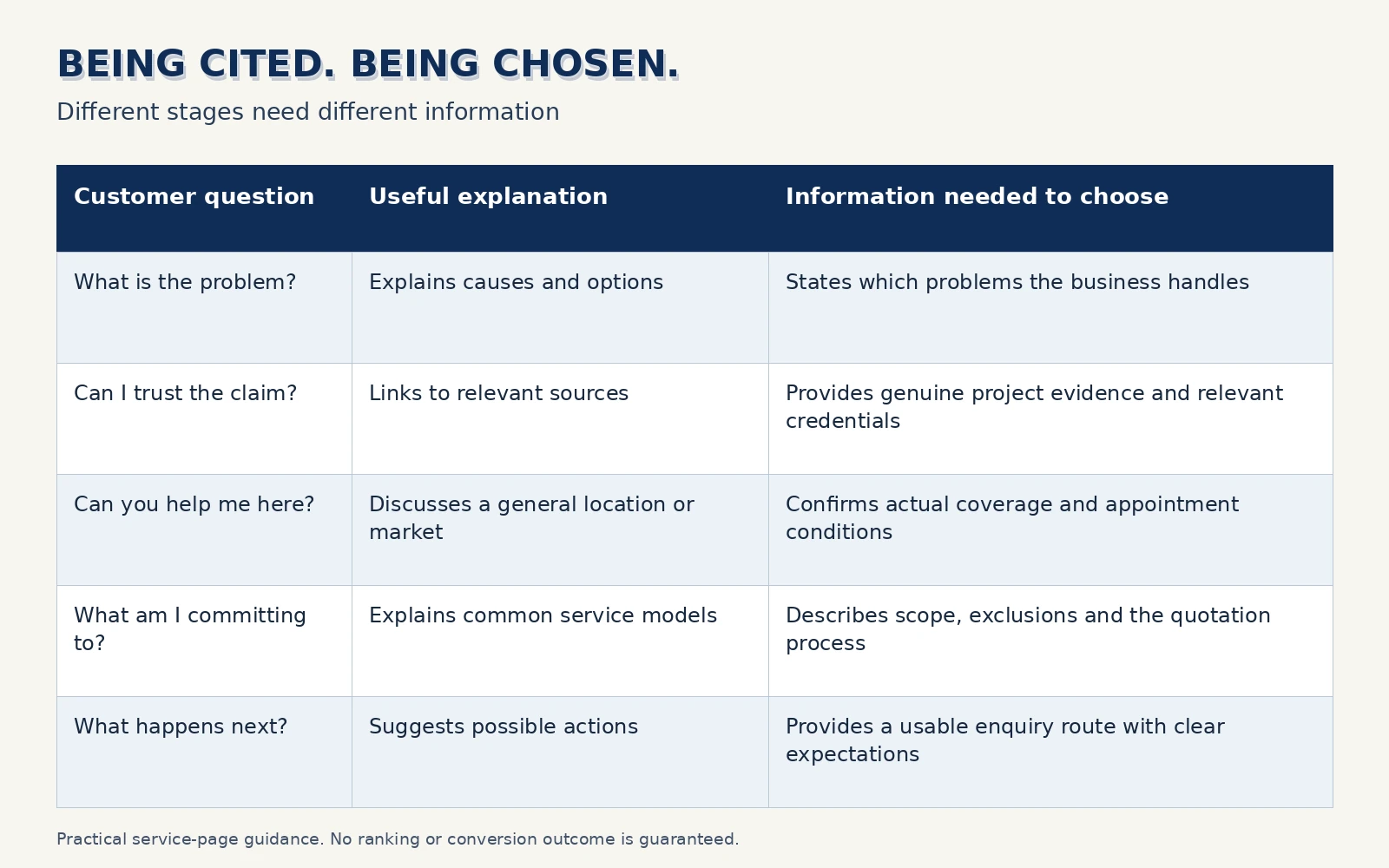
| Customer question | Useful explanation | Information needed to choose |
|---|---|---|
| What is the problem? | Explains causes and options | States which problems the business handles |
| Can I trust the claim? | Links to relevant sources | Provides genuine project evidence and relevant credentials |
| Can you help me here? | Discusses a general location or market | Confirms actual coverage and appointment conditions |
| What am I committing to? | Explains common service models | Describes scope, exclusions and the quotation process |
| What happens next? | Suggests possible actions | Provides a usable enquiry route with clear expectations |
Open the visual comparison table.
Use these five questions to review one important service page: does the service fit, is there proof, is the location suitable, is the commitment clear and is the next action easy? This is an editorial review framework, not an official AI ranking score.
“We help businesses grow” leaves almost everything unanswered. Describe the problem, the service and the customer it suits. Explain relevant exclusions too. A visitor should not have to submit a form to discover that you do not offer the required work.
For example, distinguish a once-off website assessment from monthly SEO support. The first investigates a defined set of issues; the second involves an ongoing scope. A visibility or conversion concern should lead to a defined scope. Our once-off and monthly SEO decision checklist helps choose diagnosis, repair or continuing improvement. Our AI content quality checklist helps identify vague claims and missing business facts before publication.
To support AI search conversions, put relevant evidence beside the claim it supports. A real project example should explain the original problem, work completed and documented outcome. Include dates and limits where they change the interpretation.
Avoid invented testimonials, unverified percentages and stock photographs presented as your team. If you cannot substantiate an outcome, explain your process without pretending that the process proves results.
Google’s people-first content guidance asks publishers to consider originality, evidence and clear authorship. Our Google reviews guide covers a related source of customer evidence.
A Bellville address does not explain whether you travel to Brackenfell, consult remotely across South Africa or require customers to visit. State your real operating model. Mention suburbs only when those details help someone make a decision.
For local AI search conversions, keep location, contact details and appointment conditions consistent. Our Mitchells Plain SEO and website guide applies these checks to local business decisions.For the quotation journey behind a local trade enquiry, see our website guide for plumbers, electricians and contractors. For a business that travels to customers, our Google profile address and service-area guide explains how to describe the operating model accurately. Google’s local ranking guidance explains the importance of complete business information and the roles of relevance, distance and prominence in local results. These are local search considerations, not a universal formula for every AI platform.
Use our website and Google Business Profile consistency checklist to identify contradictions that customers could encounter.
You do not need a fixed public price for a custom service. You do need to explain how the scope is determined. State what information you need, whether an assessment carries a fee and what a proposal will cover.
Where applicable, explain deposits, approval stages, ongoing commitments and exclusions accurately. Do not offer a guaranteed turnaround unless the business can honour it. Reducing uncertainty is a practical route to better AI search conversions because it makes the next decision clearer.
Review the website journey behind AI search conversions on a phone. Does the button describe its destination? Does the form ask for information needed at this stage? Are labels readable, errors understandable and confirmation messages accurate?
A button click is not a delivered lead. Test whether a submission reaches the responsible inbox and who responds. Preserve consent choices and avoid collecting sensitive information unnecessarily. For WordPress teams, the WordPress SEO service overview provides a relevant starting point for discussing technical scope.

This is a fictional example, not a client case study. Imagine a Bellville roof-repair business that accepts enquiries from Durbanville and Brackenfell. Its page currently says:
“We provide professional roofing solutions across Cape Town. Contact our expert team for quality service.”
The sentence is easy to understand but offers little help with selection. It does not identify the work, clarify the inspection process or explain what to send.
A more useful version, if every detail is true for that business, would be:
“We assess leaks and repair damaged roof sections for homeowners in Bellville, Durbanville and Brackenfell. Send your suburb, roof type and photographs through the enquiry form. We will confirm whether we can assess the job and explain any inspection fee before arranging a visit. The quotation will state the proposed repair scope and exclusions.”
This version provides decision support without claiming to be the best or promising a result. It may also help an assistant describe the service accurately. That remains something to test, not a claimed improvement in citations.
The lesson applies to tourism bookings, professional services and custom website projects: publish the facts people need before they can confidently ask for help.

A business in Mitchell’s Plain or a Khoi-owned business on the West Coast needs a page that explains its real offer, service area and buying process. Local identity provides useful context when it is accurate and shared with the owner’s consent. It does not replace evidence of the service.
For a Mitchell’s Plain trades business, state which jobs you accept, where call-outs are available and whether an inspection fee applies. Give customers a clear way to describe the problem before requesting a visit. These details help someone decide whether to enquire without assuming that every Cape Town business serves every suburb.
For a Khoi-owned West Coast enterprise selling products, tourism experiences or professional services, explain what customers can order, how delivery or bookings work and who is responsible for fulfilment. Where heritage or provenance forms part of the offer, use the business owner’s verified account and approved wording. Do not invent community endorsements, ownership claims or traditional knowledge.
A hypothetical artisan business could replace “authentic local products” with a truthful explanation of who makes the items, available order quantities, dispatch arrangements and how to request a quotation. Specific facts support both customer confidence and accurate descriptions of the business.
Our visibility guide for Khoi and San women-owned businesses explores the related discovery challenge. The next step is to connect that visibility to a clear, respectful buying journey. AI search conversions should be assessed through relevant enquiries and fulfilled orders, alongside the visibility that preceded them.
Choose an existing service page with commercial value. Save its current content and record the available baseline before editing. Use genuine customer questions to guide the work.
Preserve successful URLs and useful existing content. Add accurate structured data that agrees with the visible page, following the principles in our schema markup guide. Extra markup cannot replace missing service information.
Start with a small change you can assess. Publishing ten similar articles will not resolve an unclear offer or a failed enquiry form.
Track citations, website visits, qualified enquiries and sales separately. Connect them where your evidence permits, while keeping unknown attribution visible. Before buying a campaign, use the AI SEO proposal comparison worksheet to distinguish completed work, observed visibility and qualified enquiries.
A useful reporting sheet includes the reporting period, platform coverage, cited URLs, identifiable referral sessions, accepted enquiries and sales status. Agree on what counts as qualified before comparing results. For a service business, that might mean a genuine request within its service scope and operating area.
Use our AI visibility measurement guide for discovery metrics and the GA4 attribution guide for the website journey. Referrer loss, later branded searches and cross-device visits can leave parts of the path unobserved.
If citations rise while qualified enquiries remain flat, investigate topic relevance and the destination experience. If enquiries rise, check seasonality, campaigns and other changes before assigning credit to this article or one page edit. A citation screenshot is evidence of that appearance, not a revenue report.
Yes. An answer can reference your explanation without suggesting that someone buy from your business. Read the surrounding answer before classifying the appearance.
No. Custom services can use an enquiry model. Explain what determines the quote, what happens next and any assessment fee that applies.
No blanket removal is justified. Useful research content can support discovery and later decisions. Check its purpose, accuracy and links to relevant next steps.
No. Useful FAQs answer real questions and truthful schema describes visible content. Neither guarantees retrieval, citation, recommendation or sales.
Yes. Review one service page, record available first-party reporting and ask customers how they found you. Treat customer recall as helpful context rather than complete attribution.
If your business is getting attention but too few suitable enquiries, review the page where people must decide. Request an Easy Rank website and enquiry-journey review. Include your website address, priority service and the question customers ask before choosing you.
Editorial method: Official Google and Microsoft sources checked on 15 October 2026. The five-question framework is Easy Rank editorial analysis. The roofing business is fictional. Illustrations are AI-generated and do not depict clients or prove results. Prepared with AI assistance for David Gous’s editorial review.

David Gous is the founder of Easy Rank. He writes about search visibility, WordPress websites and practical digital growth for South African businesses. This article separates official platform guidance from editorial recommendations and a fictional example.