 Skip to content

Black Friday SEO South Africa: 11 Practical Fixes
By David Gous · · Official sources checked 28 October 2026
Categories: Small Business Marketing · SEO
Tags: Black Friday SEO · South African ecommerce · WordPress SEO · ChatGPT SEO
A practical 30-day plan for Google and AI shopping. Prepare an accurate offer, improve the product information and test the buying route before Black Friday on 27 November 2026.

In this guide
Black Friday SEO South Africa: the 30-day starting point
Black Friday SEO South Africa means preparing your offer pages, product information and buying journey so customers and search systems can understand what you sell before the promotion begins. Start with accurate stock, a useful landing page, consistent prices and a checkout that works on a phone. Then strengthen discovery through Google and relevant AI shopping experiences.
Black Friday is Friday, 27 November 2026. This 30-day preparation plan begins on 28 October. At publication on 29 October, 29 days remain before Black Friday. That is time for focused improvements, although new pages and search visibility have no guaranteed timetable. Choose work you can finish, check and maintain. For December collections and activities, our December collection and booking checklist covers holiday hours, visit requirements and booking confirmation.
This guide is for South African retailers, WooCommerce store owners and small businesses planning a genuine offer. It connects your Black Friday website checklist to customer decisions, fulfilment and measurement. The Mitchell’s Plain clothing shop and Cape Town rooibos seller below are hypothetical teaching examples. They are not client case studies or measured search results.
Easy Rank’s SEO services can help scope the relevant work. If you need the wider planning context first, our Gemini small-business workflows explain how to organise verified business information before drafting seasonal content.
Your Black Friday SEO South Africa action calendar
Use four short phases. Give each task an owner, a due date and a completion check. A smaller offer with reliable delivery is easier to manage than a large catalogue with uncertain stock.
- 28 October–3 November: choose the offer, count saleable stock, confirm costs and inspect your existing landing page. Record current orders and the mobile buying route.
- 4–10 November: improve priority product pages, take accurate photos and publish clear delivery, collection and return information. Add useful internal links.
- 11–17 November: check product data, Merchant Center issues and visible prices. Complete the three-route discovery exercise later in this guide.
- 18–26 November: test the phone checkout, sale timing, confirmation messages and fulfilment process. Fix blockers before adding more promotional traffic.
On 27 November: monitor real orders, stock and failed payments. Keep customer-facing information current. This calendar is a practical work plan, not a prediction that every search system will update by the sale date.
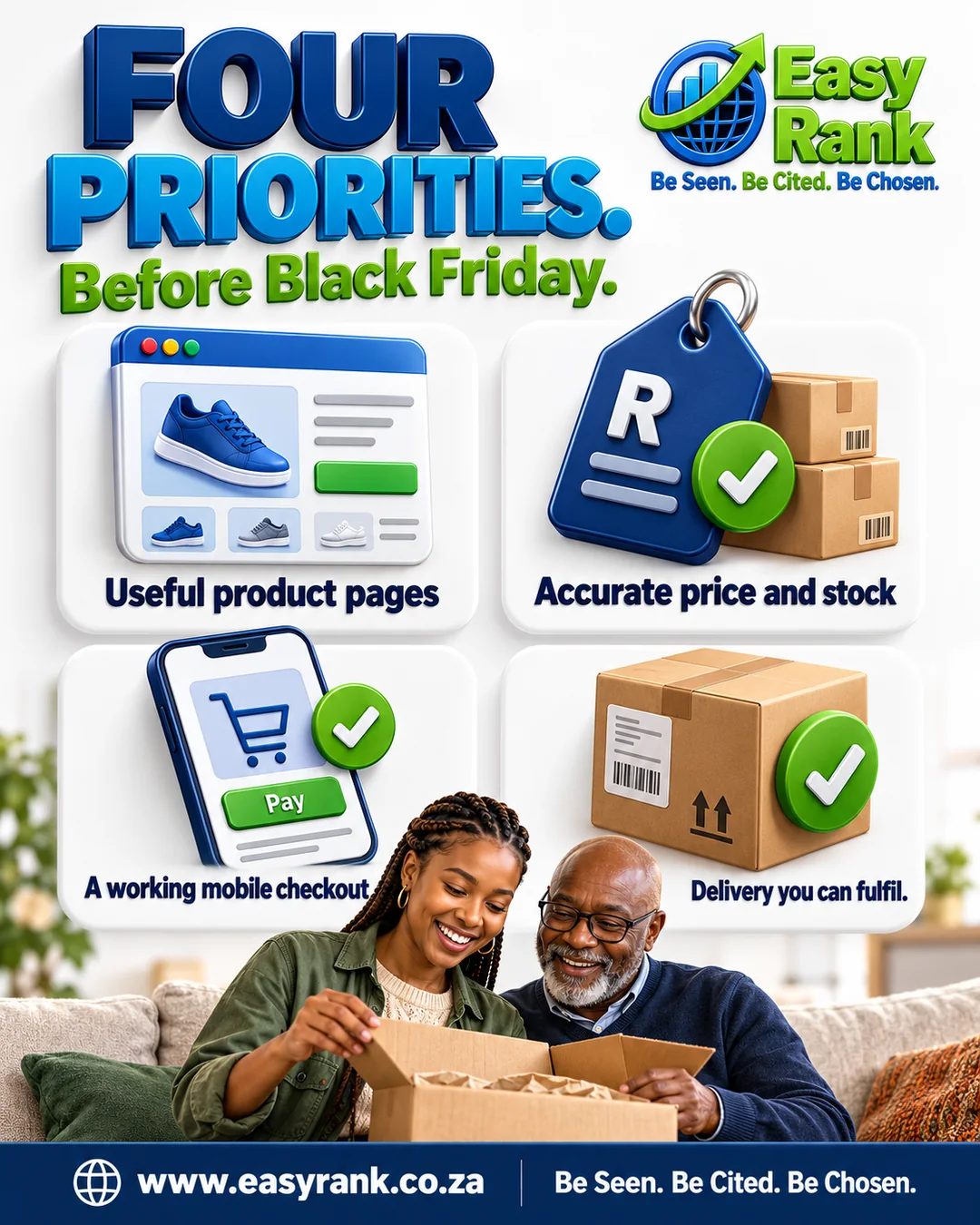
1. Choose an offer your business can fulfil
Black Friday marketing in South Africa begins with a commercial decision: what can you sell at a worthwhile contribution, in a quantity you can deliver? Confirm supplier stock, staff availability, packaging and courier or collection capacity before announcing the deal.
A hypothetical Mitchell’s Plain clothing retailer might promote one stocked jacket range with clear sizes and collection hours. A Cape Town rooibos seller might offer a gift bundle with confirmed contents and dispatch dates. Neither needs to discount every product.
Check the arithmetic. In a simplified example, a R500 sale with R300 product cost and R40 fulfilment cost leaves R160 before overheads. A 20% discount reduces the receipt to R400 and the remaining amount to R60 if those costs stay fixed. This illustration excludes VAT, returns and other costs. Use your own full cost figures.
Compare a targeted discount, a useful bundle or a modest added gift. Explain the actual value and conditions. Avoid invented scarcity, false previous prices and delivery promises your team cannot support. Record who will remove an offer when its stock or capacity is exhausted.
2. Build one useful, reusable Black Friday landing page
Give your promotion a stable destination such as /black-friday/. Keep the URL useful from year to year and update its visible dates, products and terms. Preserve an existing relevant URL where possible.
Google’s Black Friday landing-page guidance recommends publishing early, linking prominently to the page and reusing a recurring event URL. That article was published in 2020. Its old recrawl-tool maintenance note is historical, so use current Search Console instructions when requesting indexing.
The landing page should state the offer, exact start and end times in SAST, included products, important exclusions, delivery or collection arrangements and the next step. Link directly to the products customers can buy. A large poster alone leaves too many questions unanswered.
In WordPress, save a recoverable version before editing and check the published page on a phone. Keep the page crawlable if it is intended for search. Use your website handover checklist to confirm that someone has the access and responsibility to correct problems during the promotion.
3. Match product pages to real buying questions
Separate the business task from the shopper’s task. This Black Friday SEO South Africa guide targets owners improving their websites. Your shop’s pages should answer the product questions your customers actually ask.
A shopper may need an “olive overshirt in size large for collection in Mitchell’s Plain” or a “rooibos gift tin delivered to Cape Town before a stated date”. Research the actual language used in customer enquiries and available Search Console queries. These examples are prompts for research, not measured high-volume keywords.
Use product names, materials, sizes and genuine delivery or collection details naturally. Put essential information where the buying decision happens. A national delivery policy belongs on a clear supporting page, with the relevant details visible or linked from the product.
Do not duplicate the same offer across dozens of suburb pages. Our service-area page guide explains how to keep location information useful and tied to real coverage.
4. Improve one product page before editing the whole catalogue
Use this repeatable tutorial for WooCommerce Black Friday SEO. Start with a product you can fulfil reliably and whose details the owner can verify.
- Record the facts: product name, SKU, material or ingredients, variants, saleable stock, price, packaging, delivery and collection conditions.
- Write a descriptive title: use the product and distinguishing feature. Avoid making “Black Friday special” the only meaningful description.
- Answer the first decision: explain what the item is, who it suits and what is included in two or three clear sentences.
- Make variants usable: check each relevant size or colour. A parent product being available does not mean every variation is available.
- Add purchase information: show the applicable price and explain delivery, collection and returns. Link to the full policies.
- Check the action: select a variation, add it to the cart and follow the checkout using an authorised test method.
The following comparison uses fictional product details. Replace them with verified information from your own business.
| Generic version | Decision-useful version |
|---|---|
| Black Friday shirt special | Olive cotton overshirt. Confirm the fibre composition against the product label. |
| Lots of sizes available | List the sizes and show the actual stock status for each variation. |
| Fast delivery everywhere | State the available delivery areas, charges and realistic dispatch arrangements. |
| Collect locally | Give the genuine collection address, opening hours and order-ready process. |
| Great quality. Buy now. | Explain the fit, care instructions and what the customer receives, then provide a clear buying button. |
For an existing store, our WordPress SEO service can help prioritise technical and page improvements. A complete rebuild should follow evidence of a need, rather than become the default seasonal recommendation.
Example opening for a fictional rooibos gift tin: “A 100 g rooibos gift tin with the contents and ingredients shown below. Check the current price and stock before ordering. Choose an available delivery option at checkout, or follow the stated collection process.” Add verified ingredient, packaging and timing details. Do not copy this wording over missing facts.
If customers also receive a downloadable catalogue, use the PDF SEO and version-control checks to keep the document consistent with the current offer. Keep a small product fact sheet beside the editor. Ask the person responsible for stock to approve variants, the person packing orders to approve the contents and the person handling enquiries to check common questions. This makes Black Friday product pages easier to maintain when an offer changes.

5. Use accurate product images and useful image descriptions
Show the product customers will receive. Include a clear main image and relevant views of size, texture, packaging or included items. Keep the actual product colour and quantity accurate.
Use a meaningful filename, appropriate image dimensions and concise alt text that describes the picture. For example, “olive overshirt showing front pockets” is more useful than repeating a long list of towns and Black Friday keywords. Compress delivery files, retain readable detail and reserve image dimensions so the layout stays stable.
Your store’s product photography serves a different purpose from this guide’s illustrative campaign images. Generated lifestyle pictures should not create a false impression of an actual product, customer or completed result.
Our Google Lens product-image guide provides a fuller image checklist. For Black Friday SEO South Africa, complete that work on the priority products first, then expand as time allows.
6. Check Google product listings, prices and availability
Google supports free product listings in South Africa, subject to the programme’s requirements. Check your account and data-source settings, product status and any issues in Merchant Center. Eligibility does not guarantee that a product will appear. See Google’s free listings guidance.
Compare a priority product across its page, structured data and product data source. Check the product identity, currency, price, availability and destination URL. Google’s price-mismatch documentation explains how inconsistent prices and incorrectly timed sale prices can cause problems.
For a scheduled sale, check the start and end time, store timezone and the applicable sale-price effective dates. Test before the start and after the end. Do not assume that a visible sale banner has changed the product data.
Merchant listing structured data should describe the genuine visible offer. Test representative products and correct invalid or conflicting information. Do not add invented ratings, reviews or stock claims. Our schema SEO service covers implementation tied to visible content.
If you are researching Google Shopping South Africa, distinguish free listings from paid Shopping advertising and local inventory programmes. Their requirements differ. Fix the route you actually use and verify its status in the relevant account, rather than assuming that a website plugin has enrolled every product.
7. Understand what ChatGPT shopping SEO can and cannot do
OpenAI’s current shopping documentation distinguishes product results from paid ads. It describes product and merchant information, including price and availability, as inputs to shopping discovery. A recommendation, a paid placement and checkout eligibility are separate questions.
Make public product information accurate and useful, then check what a relevant shopping question returns. Do not assume that an integration, feed or special file guarantees inclusion. Check current country, merchant and account eligibility before promising any particular checkout or advertising feature to a South African business.
Google’s generative AI search guidance also keeps ordinary SEO foundations relevant. It does not prescribe a special AI schema. Useful answers and genuine product information are the basis of our recommendation, not a claim that an engine must cite your page.
Use the comparison below to keep the routes distinct. Our ChatGPT Ads South Africa guide covers the separate advertising discussion.
| Discovery route | Preparation and limits |
|---|---|
| Google web search | Publish useful crawlable pages with clear internal links. Indexing and ranking are not guaranteed. |
| Google free product listings | Check eligibility, product data and account issues. Approval does not promise a placement. |
| ChatGPT shopping results | Keep product and merchant information accurate. Test relevant questions without assuming inclusion or checkout access. |
| Paid advertising | Verify market and account eligibility, budget, creative and the destination. Paid placements are separate from organic recommendations. |
8. Complete the buying journey on a real phone
Open the promotion through the route a customer will use. If the route ends in a chat, use the WhatsApp product-enquiry checks to keep the item, contact details and confirmation step clear. Test a product link from your landing page and a shared link from a message. Choose a variation, inspect the total cost and follow the checkout using an authorised test order or gateway test mode.
Check readable text, visible buttons, useful error messages and forms that do not demand unnecessary information. Look for stock or delivery surprises introduced late in the journey. A working desktop page does not establish that a phone checkout works.
Also check the confirmation page, order record and customer message. Confirm who responds when a payment fails or collection instructions are unclear. Do not expose real customer information in screenshots or troubleshooting prompts.
Run a mobile performance check on the actual product and checkout journey. Treat a Lighthouse result as one lab observation and investigate the reported bottleneck. If the destination needs repair, our website design and improvement work should be scoped around the affected customer task.
9. Connect the offer to useful pages and genuine local information
Link the Black Friday landing page from relevant category pages, product collections and a suitable homepage section. Use descriptive links such as “view the gift bundle” or “check collection details”. Preserve existing useful links and keep navigation understandable.
For local collection, align the actual address, trading hours and order-ready process. Explain whether a customer must wait for confirmation before travelling. A hypothetical Mitchell’s Plain buyer should not arrive to find that an online order is still being packed.
Keep the relevant business profile consistent with the website. Our Google Business Profile service explains the local information work. Eligible physical retailers can also review Google’s free local listings guidance. That is a separate setup with its own requirements.
Black Friday SEO South Africa works best as a connected buying route. A promotional article, product page and collection policy should support the same verified offer.

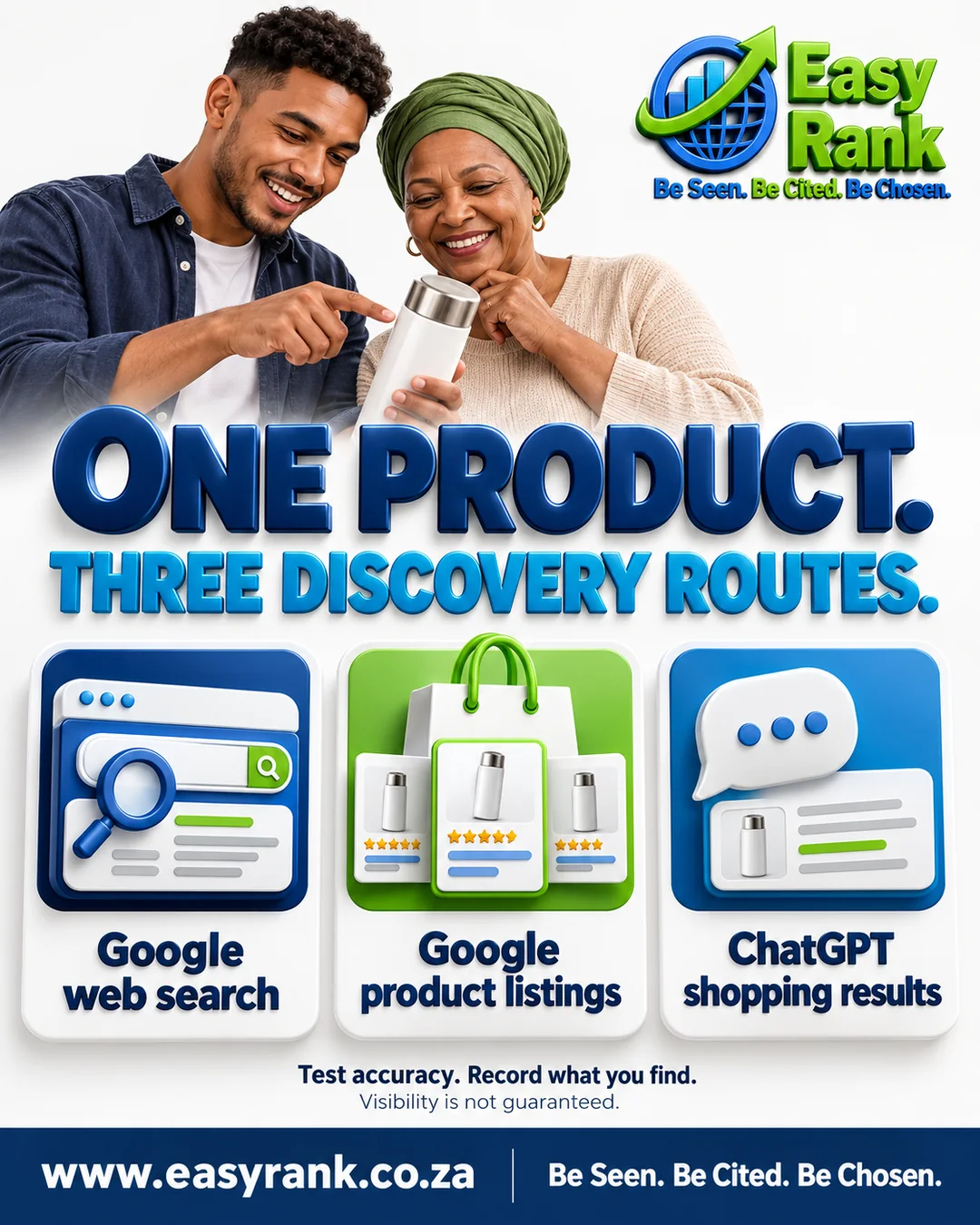
10. Run the Easy Rank exercise: one product, three discovery routes
This is a repeatable investigation, not a benchmark we claim to have completed on your business. Select one real product with the owner’s permission. Record the date, location, device, exact query and relevant account settings. Save results privately without customer data.
- Google web search: search the product name and a genuine buying question. Record whether your page appears in the results you inspected and whether the destination answers the question.
- Google product listings: inspect the relevant available shopping results and Merchant Center status. Compare the displayed price, variant and availability with the product page. If the product is absent, record “not observed in this test”.
- ChatGPT shopping: use a clear question with the product need, budget in rand and genuine delivery or collection area. Record whether shopping results appear, which products are shown and whether the linked information is accurate.
Example question: “Find a rooibos gift tin within my R300 budget that can be delivered to Cape Town. Show the product page and explain any delivery information you can verify.” Change the need and budget to match a real customer. Verify every returned claim on the merchant’s site.
Repeat a small, consistent question set at another time. Results can vary, and absence in one test does not prove a product is inaccessible everywhere. Separate discovery from the next check: can a person reach the correct product and complete the buying task?
Use the findings to choose one repair. An incorrect price calls for a data correction. Missing delivery information calls for clearer content. An unusable button calls for a journey fix. Avoid treating every finding as a reason to publish more pages.
If the product is not found: first establish what is known. Does its public URL load without a login? Can customers reach it through ordinary category links? Is the intended page indexable? Is the product approved in the relevant listing programme? Ask your technical person to investigate the failing stage. A missing recommendation does not, by itself, diagnose a crawl problem.
Keep a short observation record: route, query, product observed, facts correct, destination usable and next repair. Leave unknowns marked unknown. This record is more useful than a single unexplained “AI visibility score”.
11. Measure completed orders and keep the page useful afterwards
Record a baseline before the campaign: product-page visits, checkout starts, completed orders, cancellations, refunds and fulfilment costs where available. Keep visibility, traffic and business outcomes separate. A citation or a cart addition is not a completed sale.
Google’s GA4 ecommerce documentation describes events such as add_to_cart, begin_checkout and purchase. Check the implementation with an authorised test and use a unique transaction ID for purchase records. Reconcile analytics with the store’s orders and refunds rather than relying on a dashboard total alone.
Our search and enquiry measurement guide provides the wider context. Agree which person checks orders, stock changes and delivery exceptions during the promotion.
After the sale, remove expired claims, restore the correct prices and keep useful product information. Retain the reusable event URL with an honest end-of-sale update and relevant next steps. Review contribution and customer issues before deciding what to repeat. The purpose of Black Friday SEO South Africa is useful discovery followed by a workable buying decision.
Use a simple launch control: name a person who can pause the promotion, correct an incorrect price or stop taking orders beyond capacity. Check one live product after any bulk update. Keep the previous approved information available for recovery and record what changed. A campaign needs a working correction process as well as a publishing date.
Black Friday SEO South Africa: frequently asked questions
When should a South African business start Black Friday SEO?
Start as early as practical. For Black Friday on 27 November 2026, this plan uses 28 October–26 November for preparation. If you start later, prioritise offer accuracy, stock, the destination page and the buying journey. New rankings have no guaranteed delivery date.
Can a small South African retailer use free Google product listings?
Google lists South Africa as a supported country for free product listings. Your business and products must meet the relevant requirements. Check Merchant Center status and current guidance. Being eligible or approved does not guarantee that a product will be displayed.
Does Black Friday SEO require a discount?
No. Choose a genuine offer that suits your costs and fulfilment capacity. A useful bundle, added service or clear collection option may be relevant. Explain the actual conditions and compare the full economics before committing to a promotion.
Will product schema make ChatGPT recommend my shop?
No recommendation is guaranteed. Structured data can describe genuine visible product information for supported uses, but it is not a universal AI placement switch. Keep public facts accurate and test the discovery routes available to your business.
Should I create a new Black Friday URL every year?
Usually, retain a suitable recurring event URL and update its visible information. Review existing links and page purpose before changing it. Preserve useful assets and avoid leaving last year’s dates, offers or prices on a page presented as current.
Can Easy Rank help with the preparation?
Yes. Send your website, priority products, intended offer and the buying problem you want to improve. Easy Rank can discuss a scoped website, WordPress SEO or product-information project. The proposal should define deliverables and verification, without promising rankings or sales.
Choose the Black Friday fixes your business actually needs
Start with one offer, one reliable page and one completed buying journey. If you need a focused repair, compare the scope through our once-off versus monthly SEO guide. If a new build is justified, our AI-ready WordPress website service explains that work.
Use the SEO proposal questions to agree responsibilities, access and acceptance checks. For Black Friday SEO South Africa support, request a tailored proposal with your website, priority products and confirmed campaign dates.
About the author

David Gous is the founder of Easy Rank, a division of Bizconnexity, working with South African businesses on websites, SEO and AI search visibility. This guide combines official documentation with original planning methods and hypothetical local examples. It does not claim completed merchant integrations, search tests or client sales results.
Sources and editorial method
Official product guidance was checked on 28 October 2026. Availability and account requirements can change. The older Google seasonal article is identified by its publication year. The method and examples are editorial recommendations, not engine ranking guarantees.
- Black Friday date and campaign planning
- Google seasonal landing-page guidance, published 2020
- Google free product listings
- Google price mismatch guidance
- Google merchant listing structured data
- Google generative AI search guidance
- OpenAI shopping documentation
- Google local product listings
- Google GA4 ecommerce measurement